Zoom
In
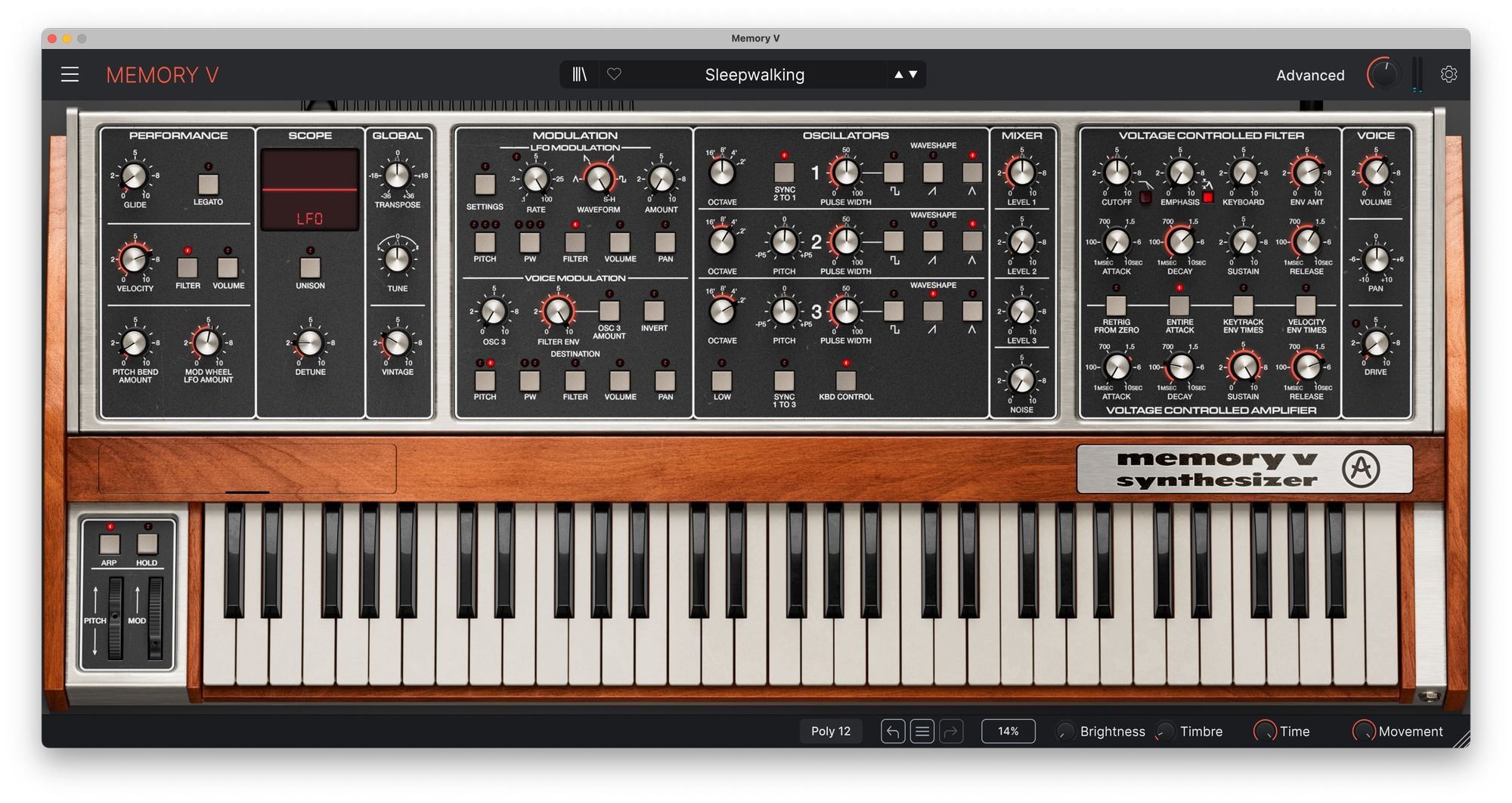
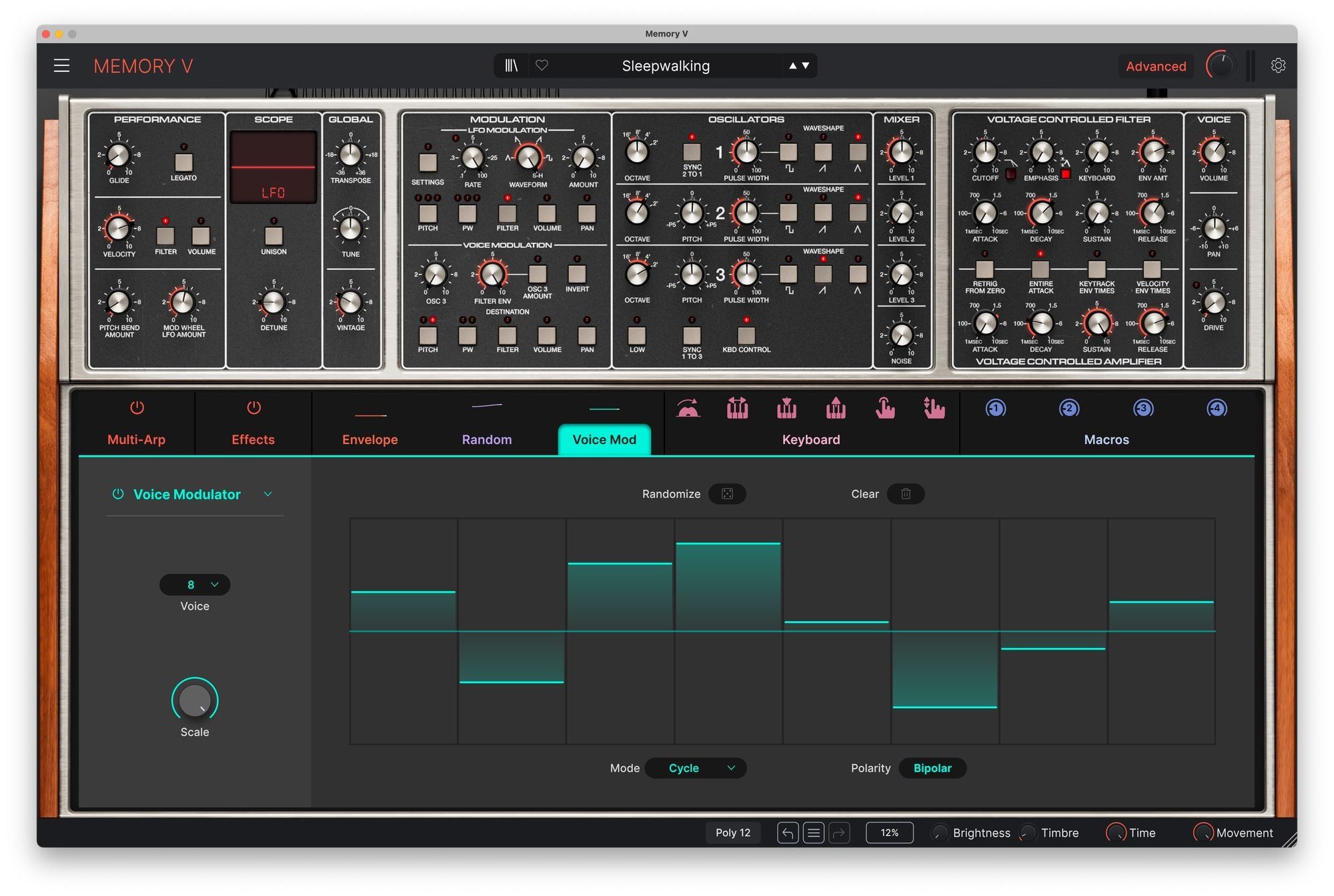
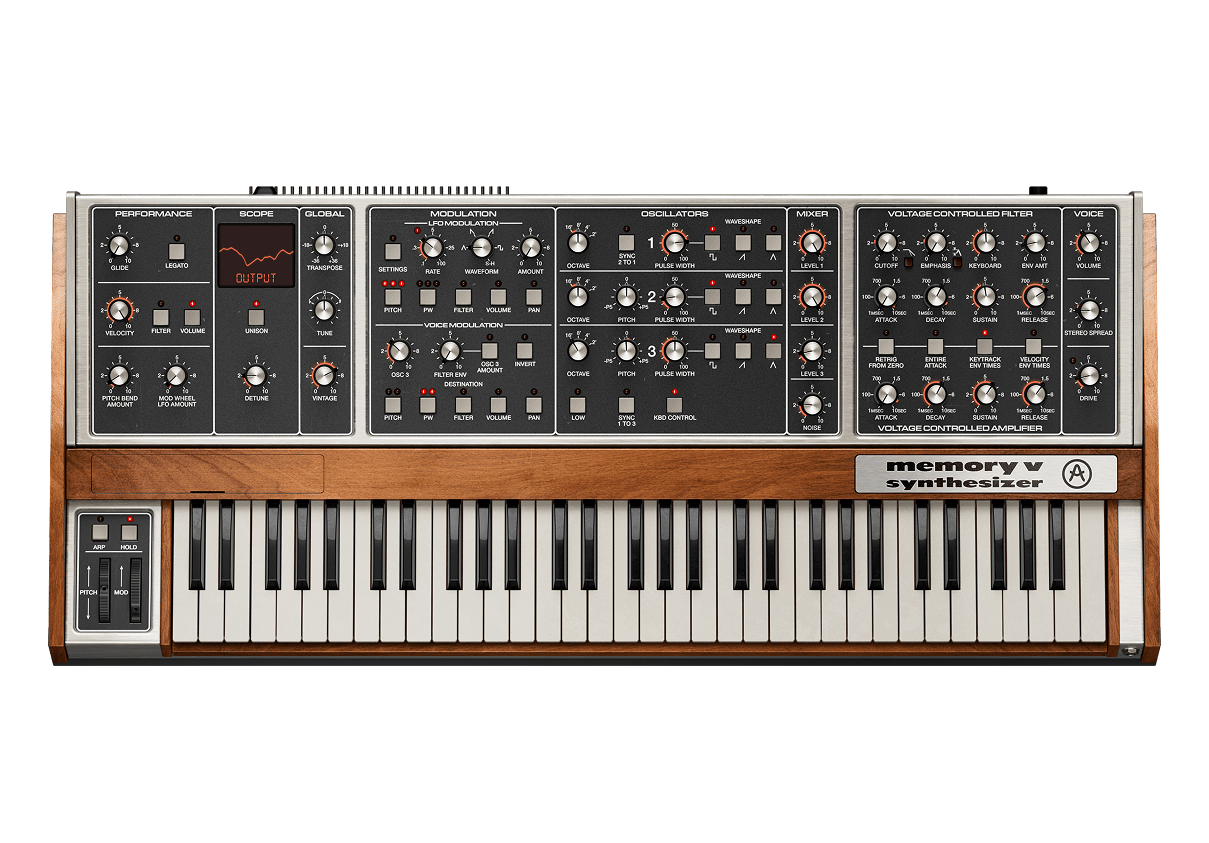
Zoom in on the panel that earned the Memorymoog its near-mythical status, and the modern enhancements that bring it up-to-spec.
Overview
Memory V
1
Performance
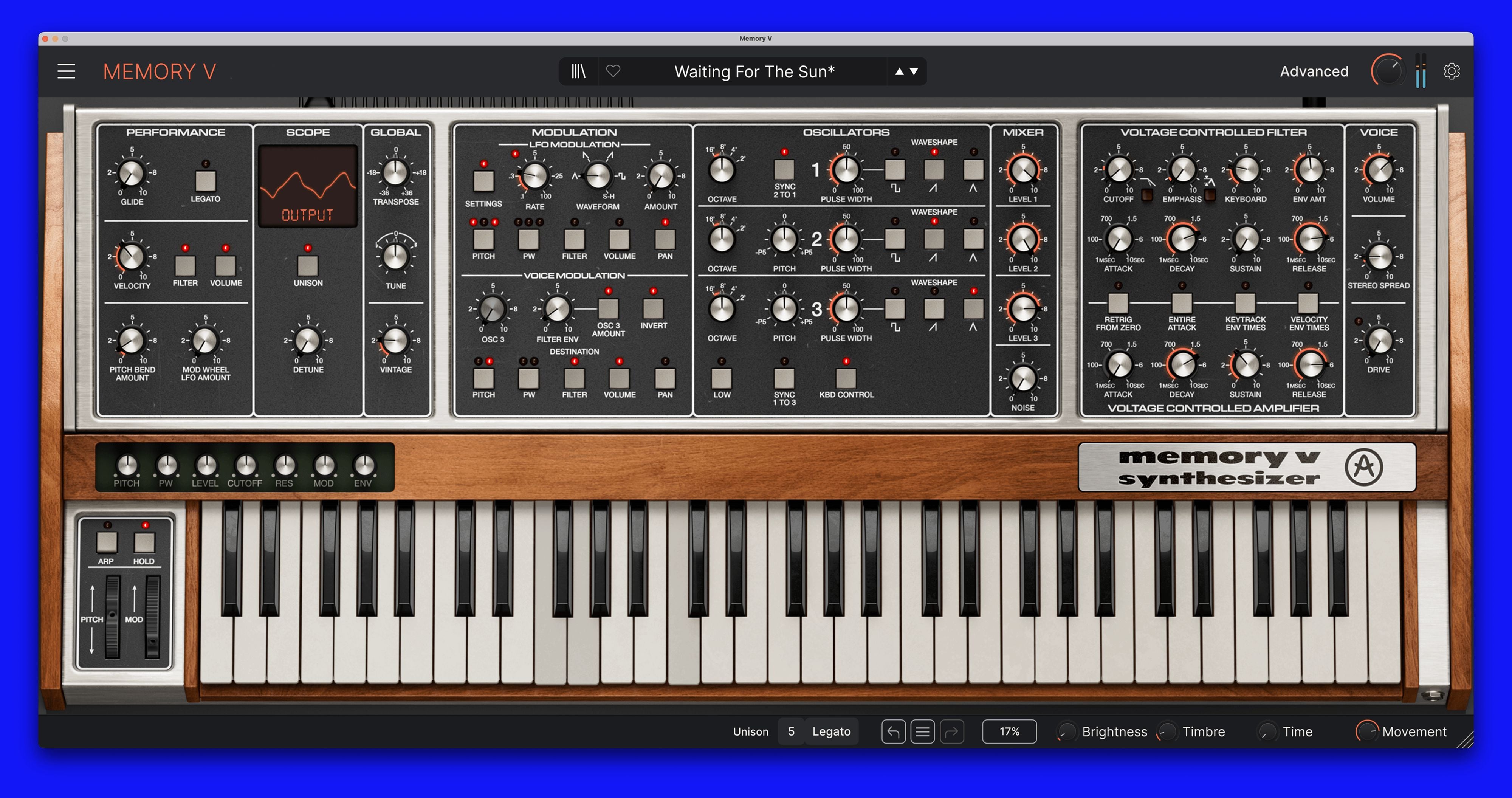
Memory V’s performance controls keep playability front and centre. Set Glide time and Legato behaviour for fluid lead phrasing, route Velocity to filter and amp response for dynamic touch and dial in Pitch Bend range or mod wheel-to-LFO depth for hands-on expression.
2
Scope
A real-time oscilloscope displays the post-FX output by default, then switches to show LFO or Voice Modulation signals when interacting with those parameters. A creative companion that turns abstract modulation into something you can see.
3
Global
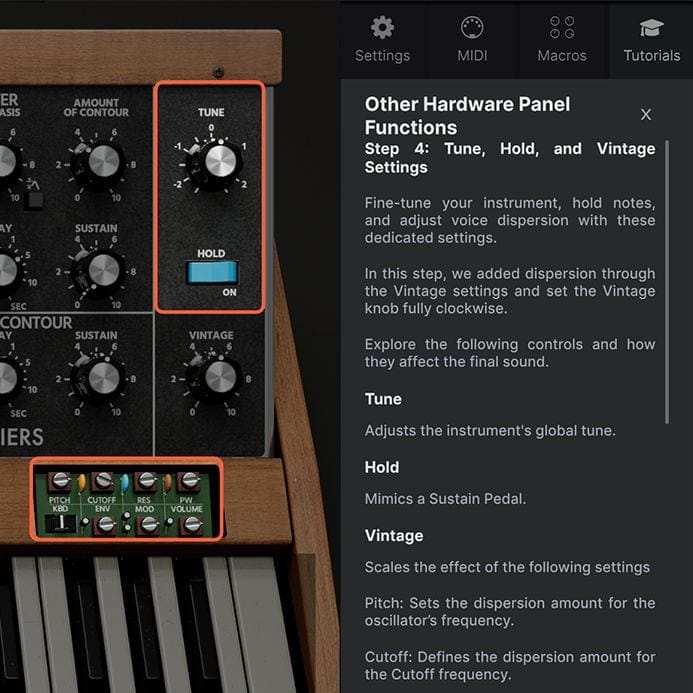
Transpose your patch up to three octaves in either direction, fine-tune master pitch from 400 to 480 Hz, and use the Vintage control to dial in continuous component drift, from clinical precision to warm, imperfect analog character.
4
LFO Modulation
A polyphonic LFO with five waveforms: Triangle, Saw, Ramp, Square and Sample & Hold. Sync to your host tempo or run freely, retrig per voice, and route movement to oscillator pitch, pulse width, filter cutoff, volume or pan.
5
Voice Modulation
A classic audio-rate modulation technique, scaled polyphonically. Route OSC 3 or the Filter Envelope to pitch, pulse width, filter, volume or pan, independently per voice. Chain the envelope into OSC 3 amount, or invert its direction for descending sweeps.
6
Triple Oscillators
Three free-running VCOs sit at the heart of every voice, with stackable Square, Ramp and Triangle waveforms, independent octave and pitch control, and pulse width modulation. Engage Sync 2-to-1 or Sync 1-to-3 for harmonically rich overtones, and unlock OSC 3 as an audio-rate modulator with Kbd Control off.
7
Mixer
Independent levels for each oscillator and the Noise generator let you dial in subtle blends or dense stacked tones. Combine all four sources for the fullest signal Memory V can produce.
8
Voltage Controlled Filter
The legendary ladder filter, modelled per voice. Shape your sound with Cutoff, Emphasis, Keyboard tracking and Filter Envelope amount, switch to a 12 dB slope or engage Bass Compensation to preserve low-end weight at extreme resonance settings.
9
Voltage Controlled Amplifier
A dedicated ADSR envelope shapes voice amplitude, with envelope behaviour controls for retriggering, attack response, keytracking and velocity-based timing. Fine-tune the dynamic response across short, long, soft and forceful playing styles.
10
Voice Output
Volume, Pan and Drive form the final stage before the FX rack. Position each voice in the stereo field, then add saturation into both the filter and amplifier for harmonic richness, edge and analogue colour.
11
Advanced Functions
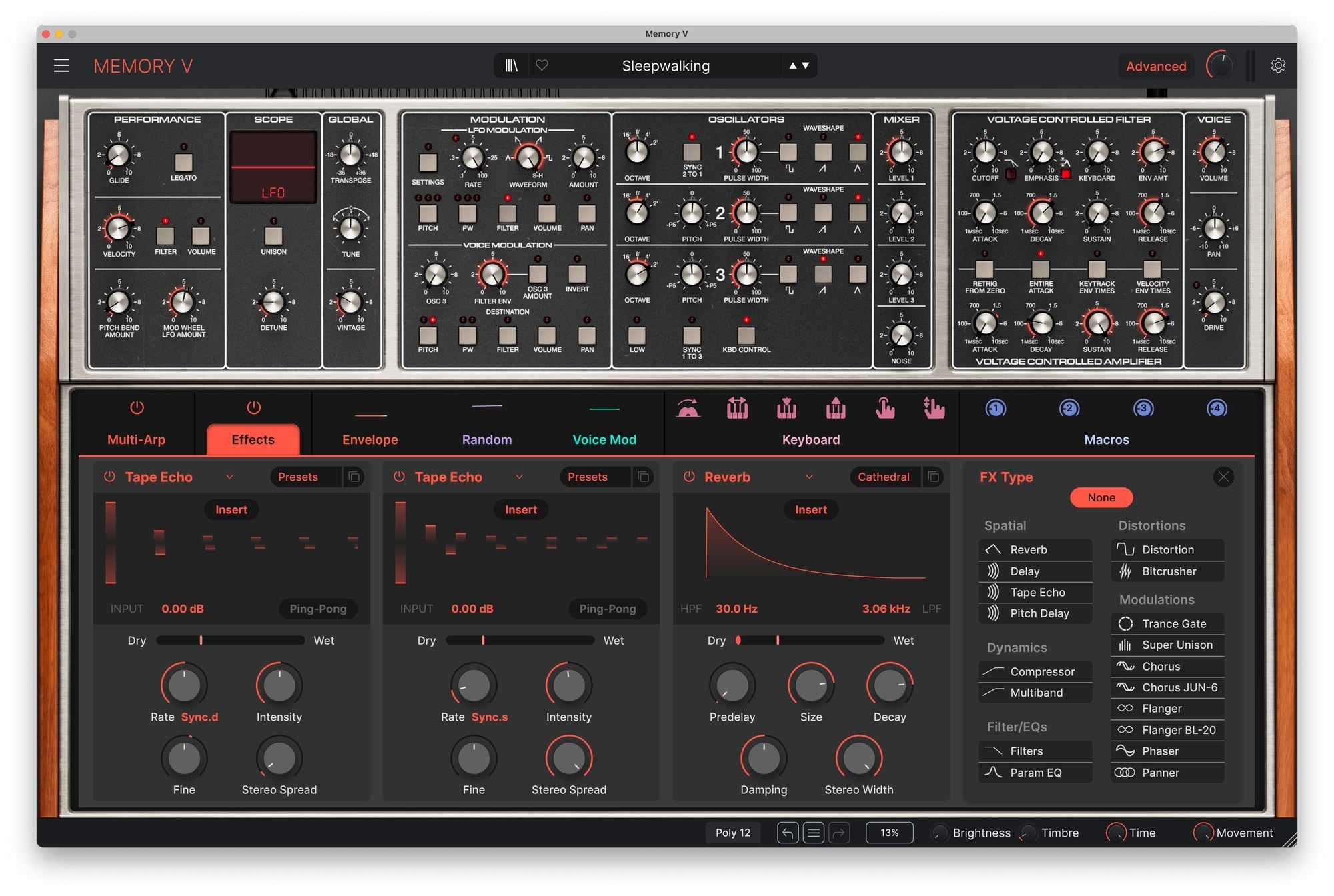
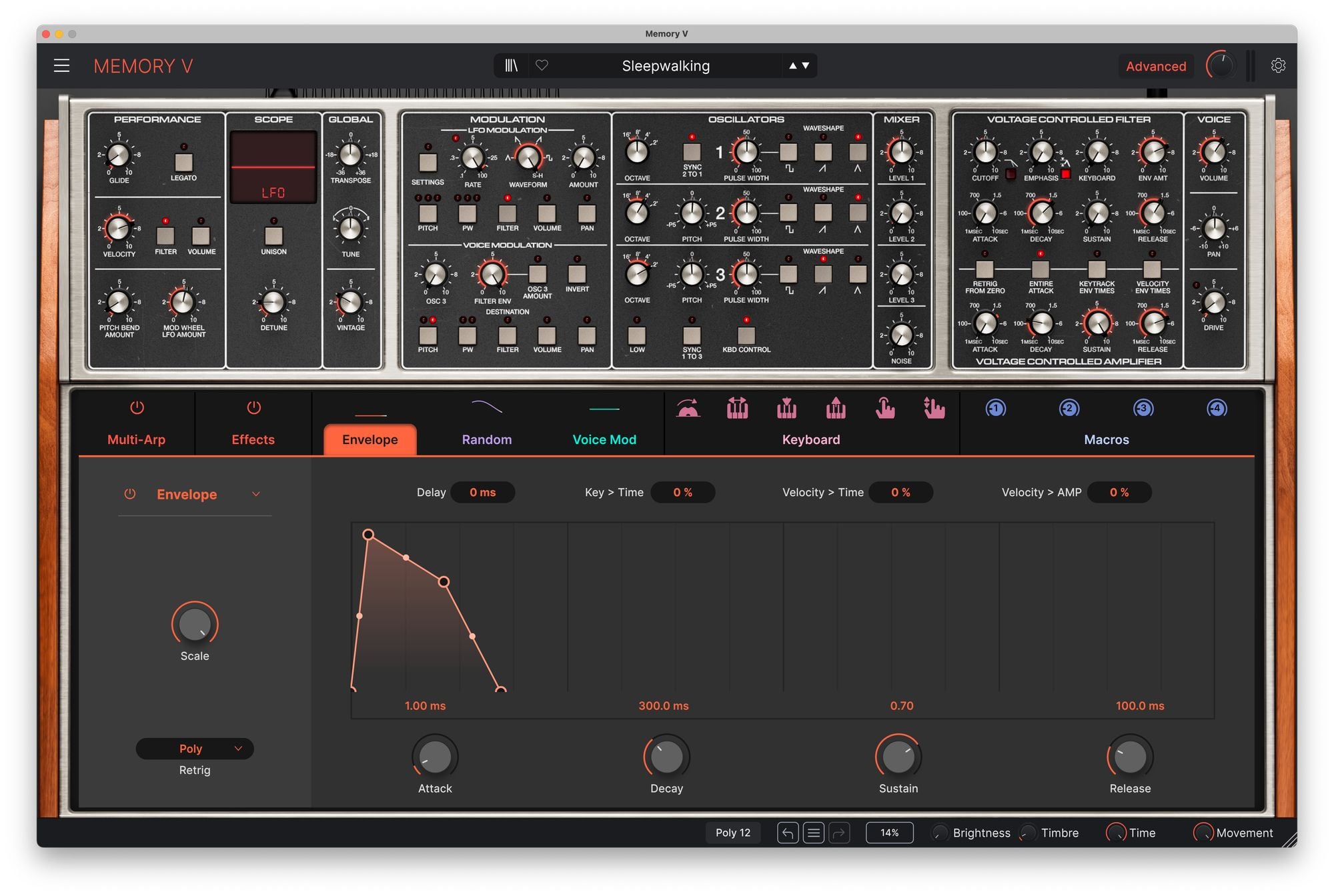
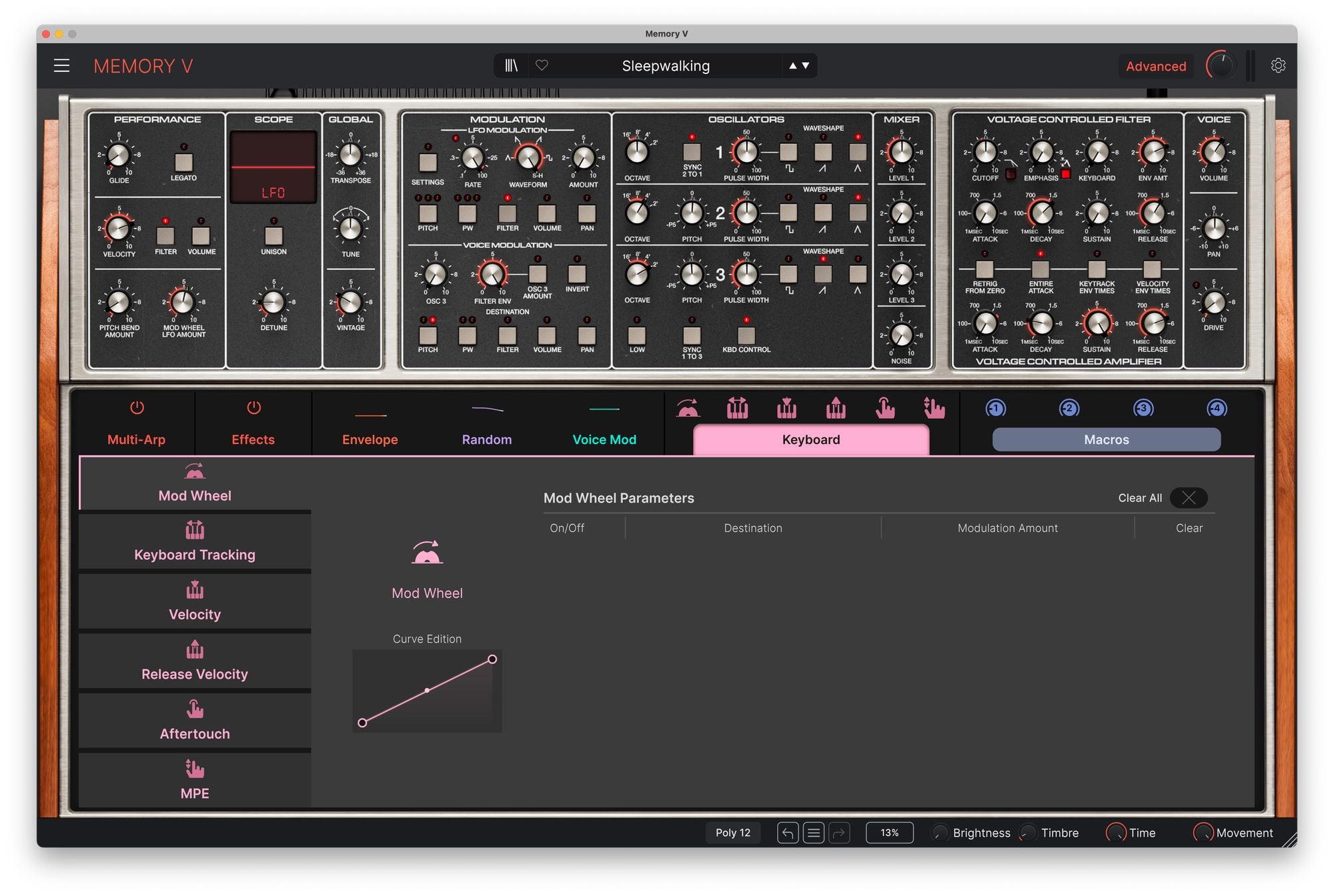
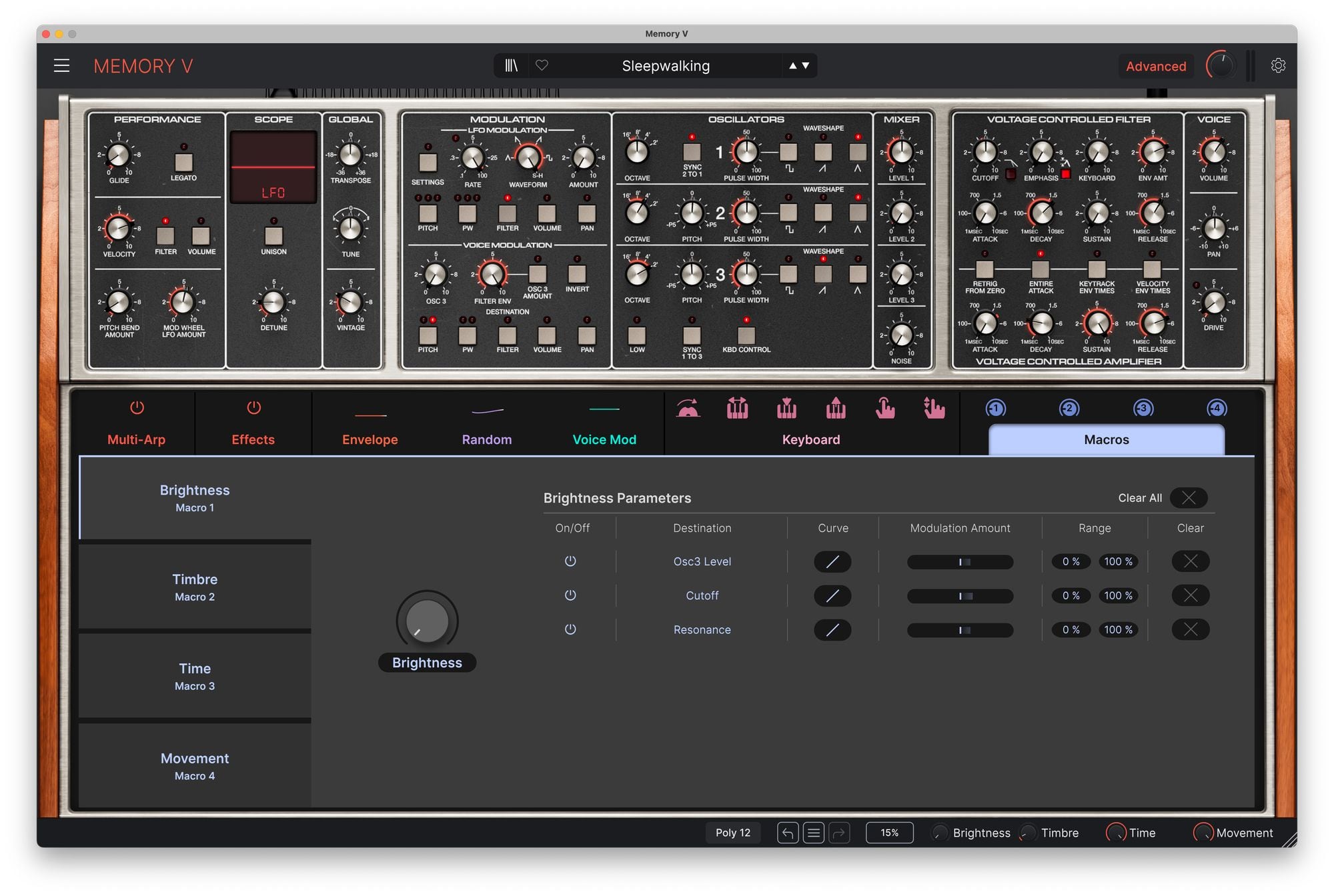
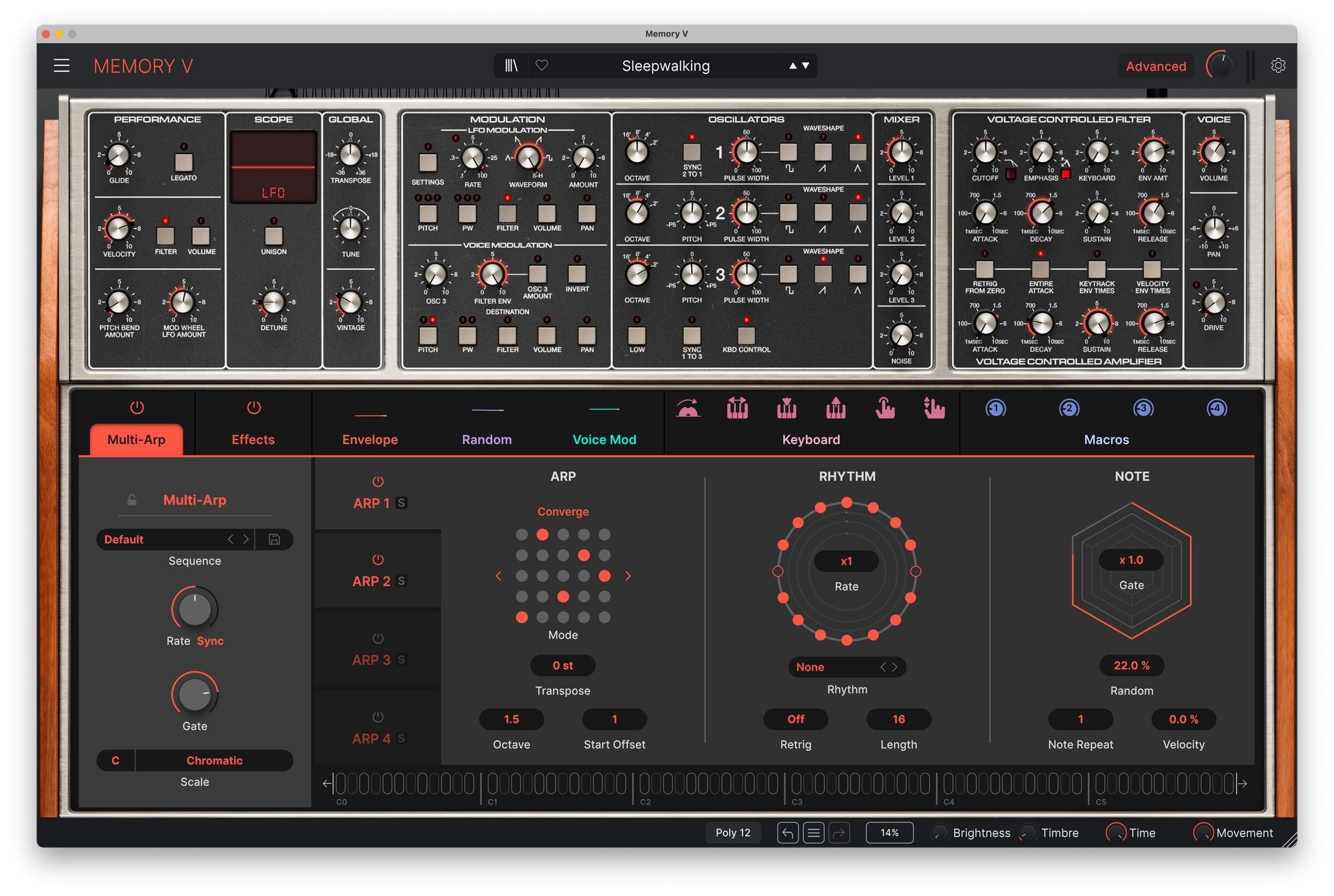
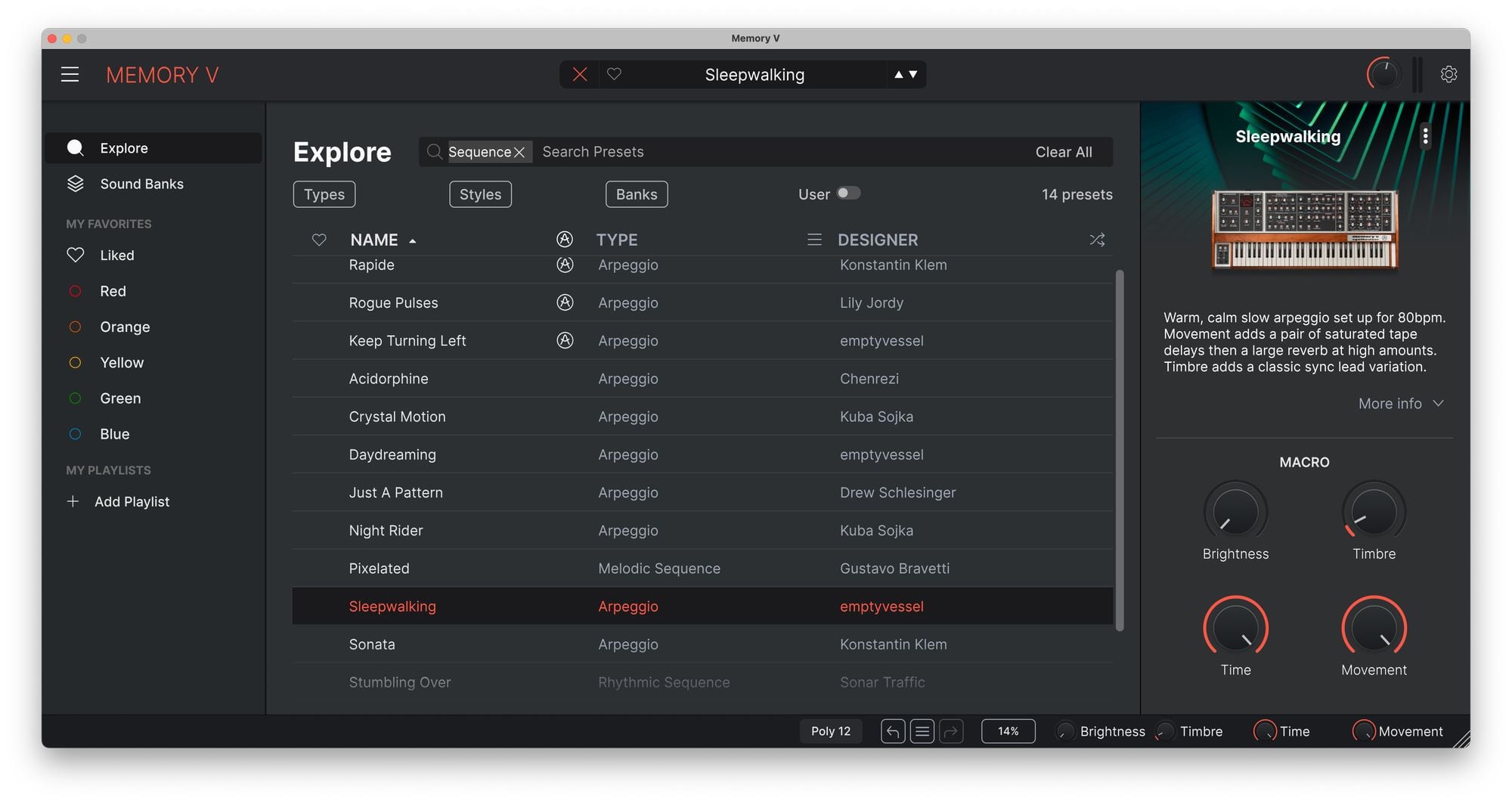
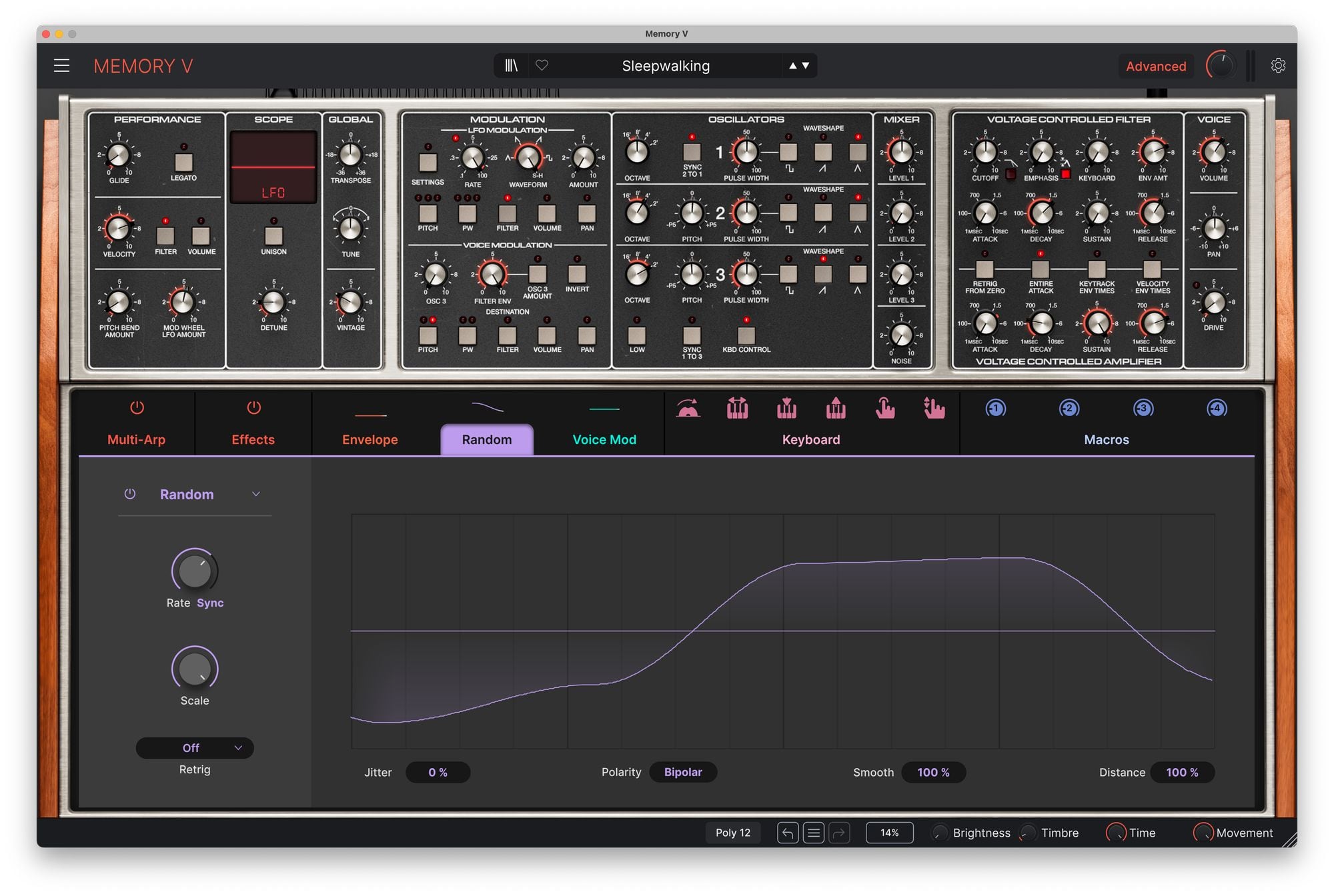
Access the Advanced panel to shape Memory V with four-layer arpeggiation, drag-and-drop modulation, expressive keyboard controls, macros and studio-grade effects.
Overview
Memory V
1
Performance
Memory V’s performance controls keep playability front and centre. Set Glide time and Legato behaviour for fluid lead phrasing, route Velocity to filter and amp response for dynamic touch and dial in Pitch Bend range or mod wheel-to-LFO depth for hands-on expression.
2
Scope
A real-time oscilloscope displays the post-FX output by default, then switches to show LFO or Voice Modulation signals when interacting with those parameters. A creative companion that turns abstract modulation into something you can see.
3
Global
Transpose your patch up to three octaves in either direction, fine-tune master pitch from 400 to 480 Hz, and use the Vintage control to dial in continuous component drift, from clinical precision to warm, imperfect analog character.
4
LFO Modulation
A polyphonic LFO with five waveforms: Triangle, Saw, Ramp, Square and Sample & Hold. Sync to your host tempo or run freely, retrig per voice, and route movement to oscillator pitch, pulse width, filter cutoff, volume or pan.
5
Voice Modulation
A classic audio-rate modulation technique, scaled polyphonically. Route OSC 3 or the Filter Envelope to pitch, pulse width, filter, volume or pan, independently per voice. Chain the envelope into OSC 3 amount, or invert its direction for descending sweeps.
6
Triple Oscillators
Three free-running VCOs sit at the heart of every voice, with stackable Square, Ramp and Triangle waveforms, independent octave and pitch control, and pulse width modulation. Engage Sync 2-to-1 or Sync 1-to-3 for harmonically rich overtones, and unlock OSC 3 as an audio-rate modulator with Kbd Control off.
7
Mixer
Independent levels for each oscillator and the Noise generator let you dial in subtle blends or dense stacked tones. Combine all four sources for the fullest signal Memory V can produce.
8
Voltage Controlled Filter
The legendary ladder filter, modelled per voice. Shape your sound with Cutoff, Emphasis, Keyboard tracking and Filter Envelope amount, switch to a 12 dB slope or engage Bass Compensation to preserve low-end weight at extreme resonance settings.
9
Voltage Controlled Amplifier
A dedicated ADSR envelope shapes voice amplitude, with envelope behaviour controls for retriggering, attack response, keytracking and velocity-based timing. Fine-tune the dynamic response across short, long, soft and forceful playing styles.
10
Voice Output
Volume, Pan and Drive form the final stage before the FX rack. Position each voice in the stereo field, then add saturation into both the filter and amplifier for harmonic richness, edge and analogue colour.
11
Advanced Functions
Access the Advanced panel to shape Memory V with four-layer arpeggiation, drag-and-drop modulation, expressive keyboard controls, macros and studio-grade effects.
Overview
Memory V
1
Performance
Memory V’s performance controls keep playability front and centre. Set Glide time and Legato behaviour for fluid lead phrasing, route Velocity to filter and amp response for dynamic touch and dial in Pitch Bend range or mod wheel-to-LFO depth for hands-on expression.
2
Scope
A real-time oscilloscope displays the post-FX output by default, then switches to show LFO or Voice Modulation signals when interacting with those parameters. A creative companion that turns abstract modulation into something you can see.
3
Global
Transpose your patch up to three octaves in either direction, fine-tune master pitch from 400 to 480 Hz, and use the Vintage control to dial in continuous component drift, from clinical precision to warm, imperfect analog character.
4
LFO Modulation
A polyphonic LFO with five waveforms: Triangle, Saw, Ramp, Square and Sample & Hold. Sync to your host tempo or run freely, retrig per voice, and route movement to oscillator pitch, pulse width, filter cutoff, volume or pan.
5
Voice Modulation
A classic audio-rate modulation technique, scaled polyphonically. Route OSC 3 or the Filter Envelope to pitch, pulse width, filter, volume or pan, independently per voice. Chain the envelope into OSC 3 amount, or invert its direction for descending sweeps.
6
Triple Oscillators
Three free-running VCOs sit at the heart of every voice, with stackable Square, Ramp and Triangle waveforms, independent octave and pitch control, and pulse width modulation. Engage Sync 2-to-1 or Sync 1-to-3 for harmonically rich overtones, and unlock OSC 3 as an audio-rate modulator with Kbd Control off.
7
Mixer
Independent levels for each oscillator and the Noise generator let you dial in subtle blends or dense stacked tones. Combine all four sources for the fullest signal Memory V can produce.
8
Voltage Controlled Filter
The legendary ladder filter, modelled per voice. Shape your sound with Cutoff, Emphasis, Keyboard tracking and Filter Envelope amount, switch to a 12 dB slope or engage Bass Compensation to preserve low-end weight at extreme resonance settings.
9
Voltage Controlled Amplifier
A dedicated ADSR envelope shapes voice amplitude, with envelope behaviour controls for retriggering, attack response, keytracking and velocity-based timing. Fine-tune the dynamic response across short, long, soft and forceful playing styles.
10
Voice Output
Volume, Pan and Drive form the final stage before the FX rack. Position each voice in the stereo field, then add saturation into both the filter and amplifier for harmonic richness, edge and analogue colour.
11
Advanced Functions
Access the Advanced panel to shape Memory V with four-layer arpeggiation, drag-and-drop modulation, expressive keyboard controls, macros and studio-grade effects.
1
2
3
4
5
6
7
8
9
10
11