ARTURIA

ja

Memory V

ラダーフィルター搭載のアナログ・タイタン

Memory V is out!

Enjoy a limited-time discount on Memory V, or explore it alongside the full V Collection for an exclusive price.

Valid until June 14th, 2026.

すでにArturiaのアカウントをお持ちですか?

Wield
phenomenal power

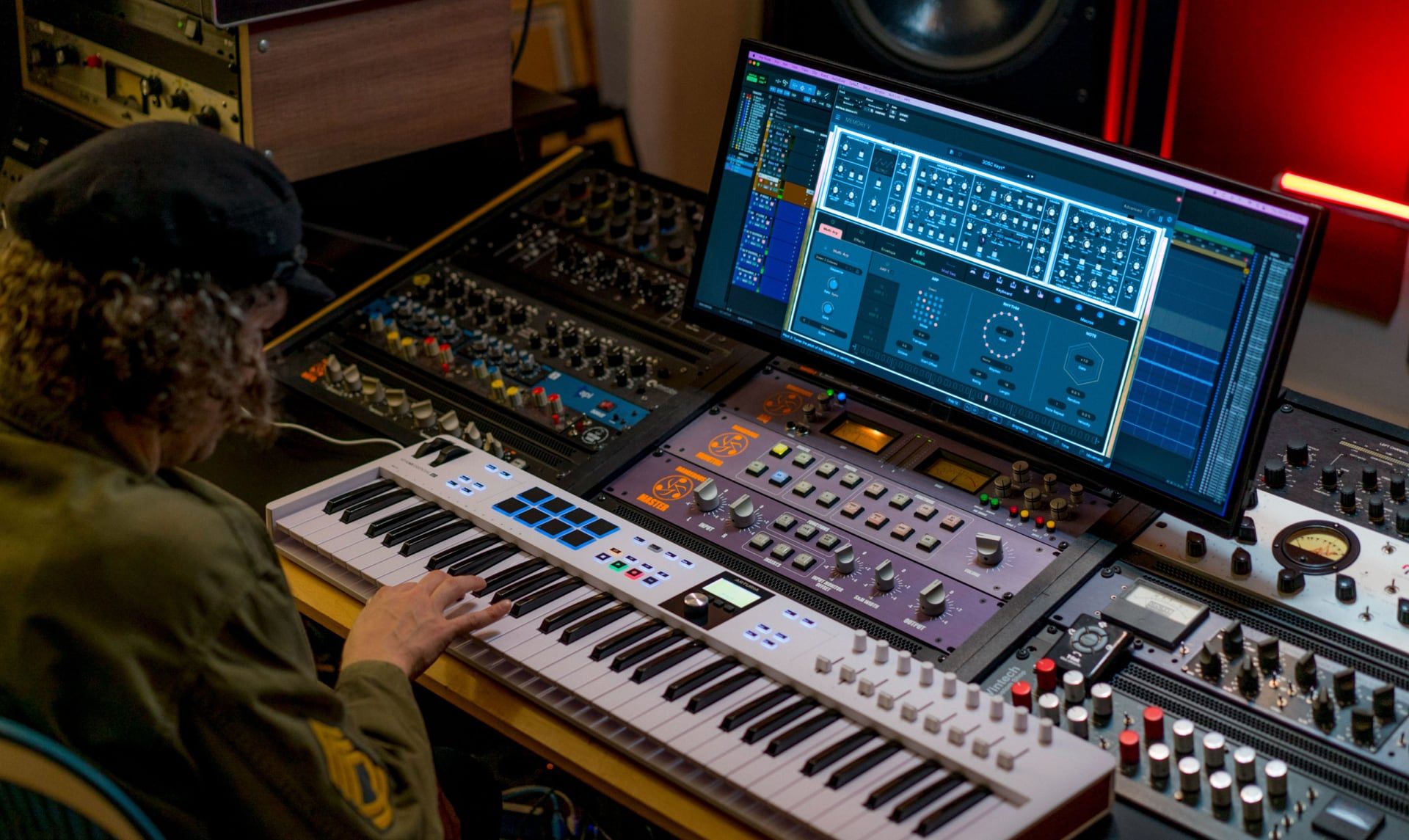
Memory V resurrects the analog majesty of the 1982 Memorymoog with breathtaking authenticity. Build towering brass, dense basses, evolving leads and cinematic pads with the living instability and triple-osc depth of a polyphonic classic - augmented for modern production.

クラス最高峰の再現度

Discover the weight, movement and edge of the original hardware, preserved through component-accurate TAE® modelling of its oscillators, filter, mixer, drive and analog non-linearities.

Enhanced for modern production

Drag-and-drop modulation, a four-layer Multi-Arp, a 4-slot FX rack, MPE support and Poly 12 voicing extend the Memorymoog into territory the hardware never could reach.

Mix-ready sound library

Explore 300+ presets crafted by Arturia’s sound design team, spanning vintage brass, basses and keys to modern electronic textures, cinematic pads and expressive performance sounds.

Unmatched
weight and presence

Hear the dense character of Memory V across genres, from synthwave nostalgia to modern electronic, ambient, R&B and beyond.

New Los Angeles

Timecop1983

Neon-lit analog synths with arpeggiated leads, wide pads, and steady retro drum machines evoking night drives and futuristic nostalgia.

Last Transmission

Andrew Beaton

Expansive orchestral-synth hybrids with evolving textures, deep drones, and dynamic percussions designed for narrative tension and scale.

Memory Leak

GOTNOTIME

Hard-hitting 808-driven beats with sharp hats, dark melodic synths, and tense atmospheres built around minimal, aggressive grooves.

Pacific Bounce

Maxime Desormieres

Raw, bass-heavy groove with punchy drums, gritty synth stabs, and loose rhythmic swing inspired by urban funk and lowrider culture.

Polaroid Summer

Jamie Wilder

Bright, polished analog synths with catchy hooks, lush pads, and upbeat melodic progressions in classic radio style.

Chrome Decay

Deru

An ambient tape voyage where Memory Moog unfolds into creamy analog fields of warm filtered keys and soft evolving pads.

A true
analog titan

Memory V honours the architecture that defined an era of polyphonic synthesis, and adds the tools you need to push it further.

Triple-oscillator architecture

Three free-running oscillators per voice deliver the harmonic depth that set the Memorymoog apart. Stack Square, Ramp and Triangle waveforms, shape pulse width and sync oscillators for rich, animated sounds.

Legendary ladder filter

The 24 dB low-pass ladder filter that defined the Moog sound, modelled in component-accurate detail. Switch to 12 dB slope, push into self-oscillation, or engage Bass Compensation to preserve the low-end at higher resonance.

Voice modulation depth

Route audio-rate OSC 3 or the Filter Envelope to pitch, pulse width, filter, volume or pan, independently per voice. Chain the envelope into OSC 3 amount for shifting FM-style movement and evolving instability.

Authentic analog feel

Recreate the idiosyncrasy and personality of an OG Memorymoog with Vintage and Dispersion controls. Introduce continuous analog drift, then fine-tune variation across pitch, pulse width, levels, cutoff, emphasis, modulation and envelope times.

Polyphonic power, expanded

Move between the original six-voice architecture and expanded Poly 12 mode. Engage Unison, add detune and spread the result across the stereo field for a dense, immediate sound that fills the mix from a single key press.

Modern modulation and FX

Drag-and-drop modulation, a four-layer Multi-Arp and a 4-slot FX rack with 17+ studio-grade effects bring contemporary sound design into a vintage-inspired architecture without losing its analogue identity.

Zoom
In

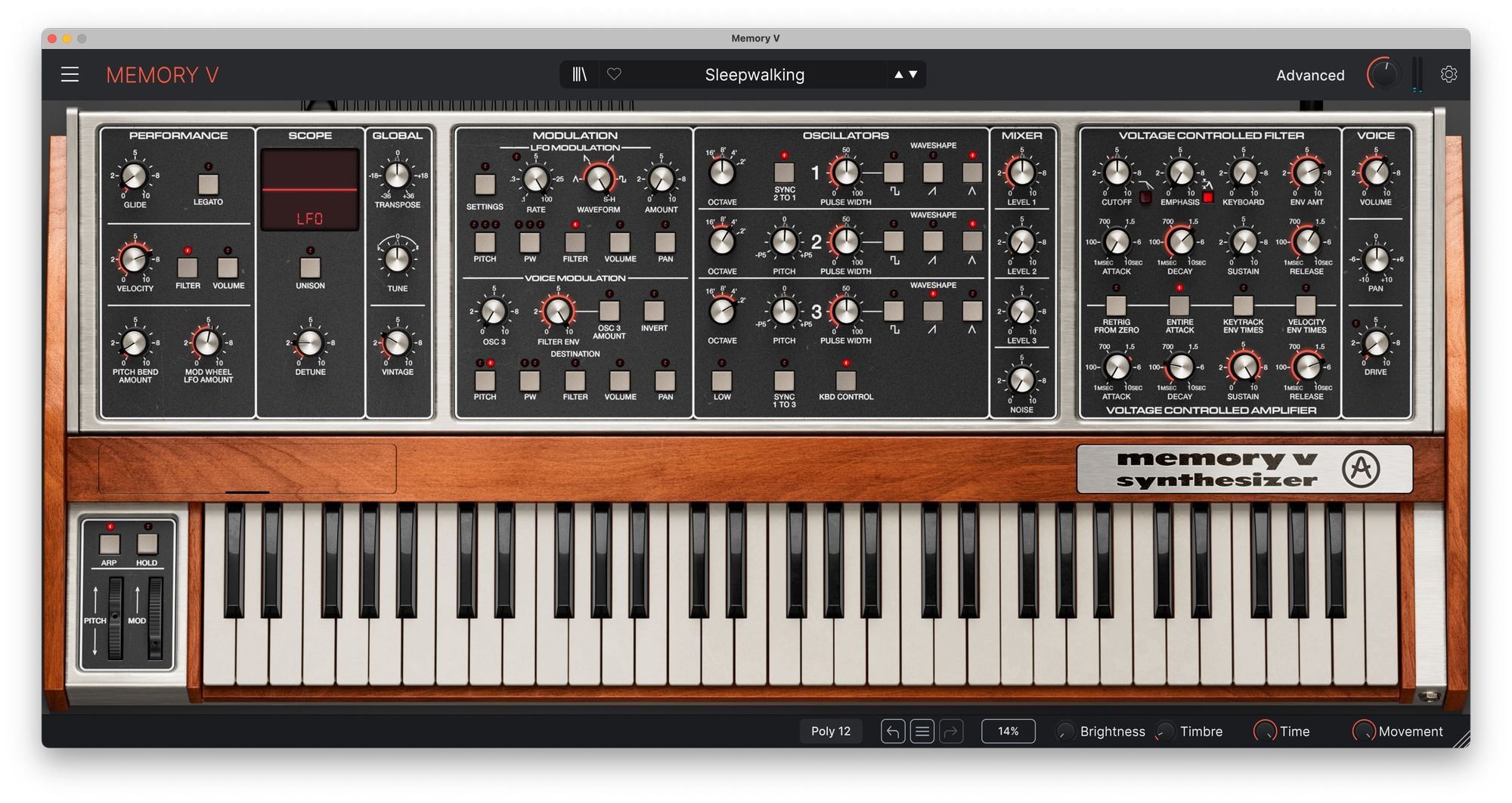
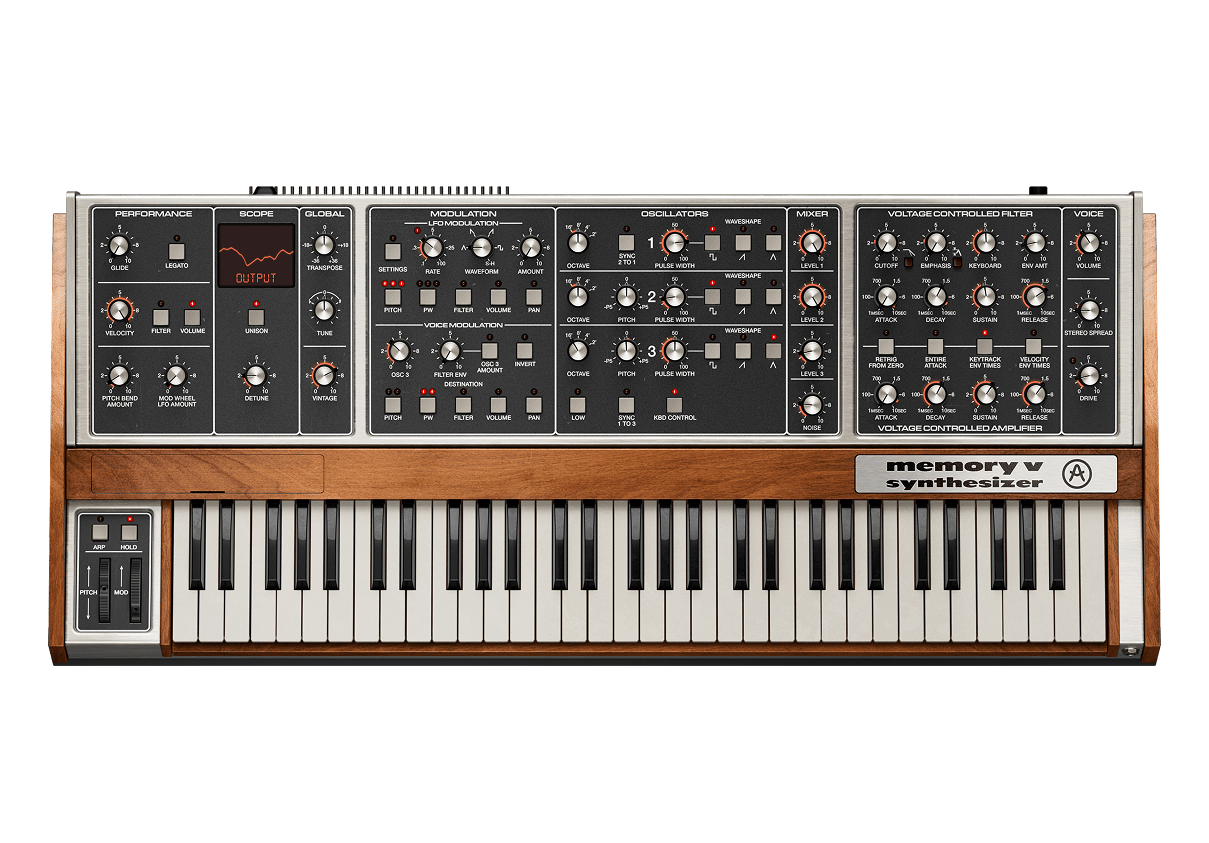
Zoom in on the panel that earned the Memorymoog its near-mythical status, and the modern enhancements that bring it up-to-spec.

Overview

Memory V

1

性能

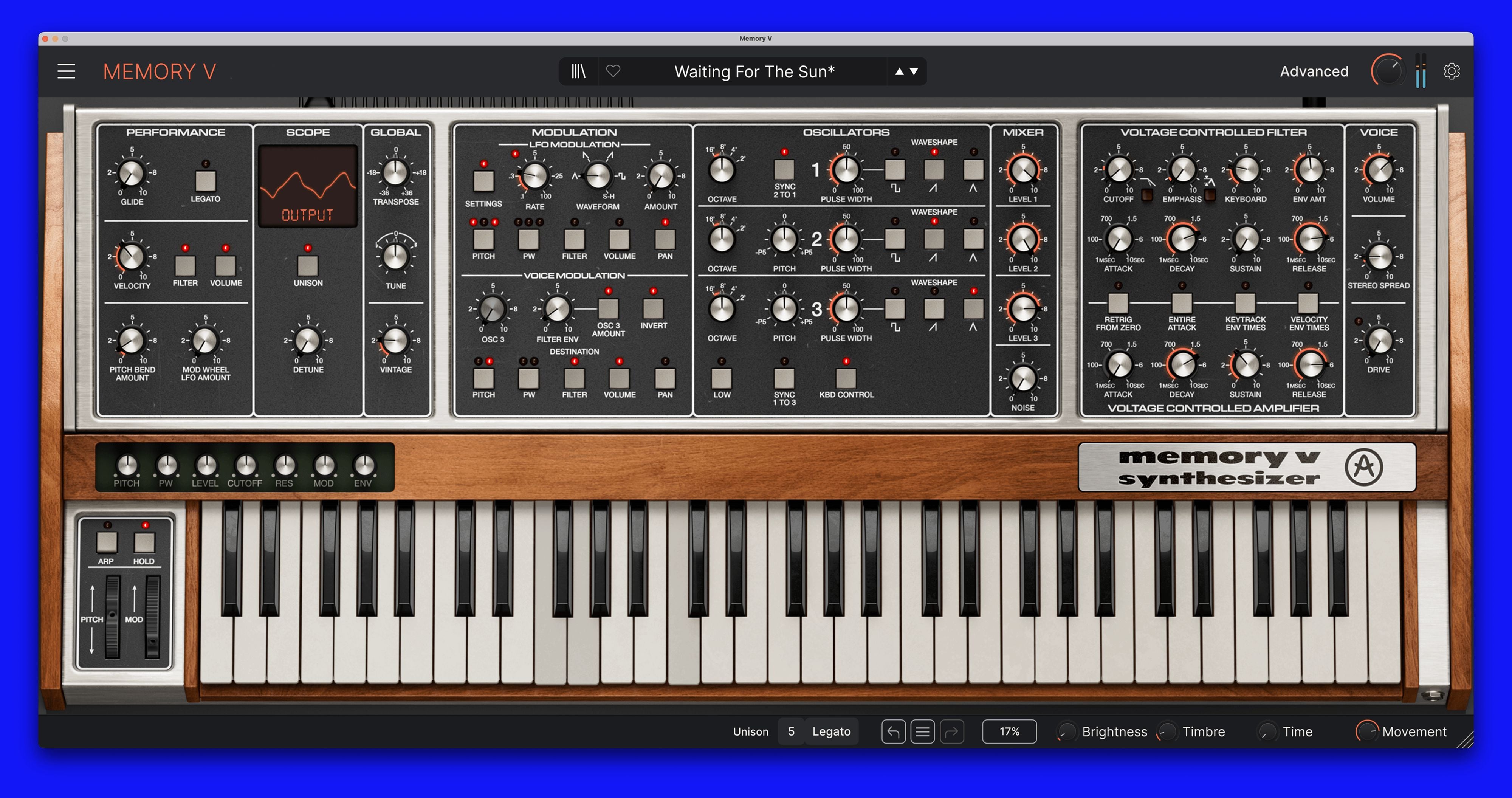
Memory V’s performance controls keep playability front and centre. Set Glide time and Legato behaviour for fluid lead phrasing, route Velocity to filter and amp response for dynamic touch and dial in Pitch Bend range or mod wheel-to-LFO depth for hands-on expression.

2

Scope

A real-time oscilloscope displays the post-FX output by default, then switches to show LFO or Voice Modulation signals when interacting with those parameters. A creative companion that turns abstract modulation into something you can see.

3

Global

Transpose your patch up to three octaves in either direction, fine-tune master pitch from 400 to 480 Hz, and use the Vintage control to dial in continuous component drift, from clinical precision to warm, imperfect analog character.

4

LFO Modulation

A polyphonic LFO with five waveforms: Triangle, Saw, Ramp, Square and Sample & Hold. Sync to your host tempo or run freely, retrig per voice, and route movement to oscillator pitch, pulse width, filter cutoff, volume or pan.

5

Voice Modulation

A classic audio-rate modulation technique, scaled polyphonically. Route OSC 3 or the Filter Envelope to pitch, pulse width, filter, volume or pan, independently per voice. Chain the envelope into OSC 3 amount, or invert its direction for descending sweeps.

6

Triple Oscillators

Three free-running VCOs sit at the heart of every voice, with stackable Square, Ramp and Triangle waveforms, independent octave and pitch control, and pulse width modulation. Engage Sync 2-to-1 or Sync 1-to-3 for harmonically rich overtones, and unlock OSC 3 as an audio-rate modulator with Kbd Control off.

7

ミキサー

Independent levels for each oscillator and the Noise generator let you dial in subtle blends or dense stacked tones. Combine all four sources for the fullest signal Memory V can produce.

8

Voltage Controlled Filter

The legendary ladder filter, modelled per voice. Shape your sound with Cutoff, Emphasis, Keyboard tracking and Filter Envelope amount, switch to a 12 dB slope or engage Bass Compensation to preserve low-end weight at extreme resonance settings.

9

Voltage Controlled Amplifier

A dedicated ADSR envelope shapes voice amplitude, with envelope behaviour controls for retriggering, attack response, keytracking and velocity-based timing. Fine-tune the dynamic response across short, long, soft and forceful playing styles.

10

Voice Output

Volume, Pan and Drive form the final stage before the FX rack. Position each voice in the stereo field, then add saturation into both the filter and amplifier for harmonic richness, edge and analogue colour.

11

Advanced Functions

Access the Advanced panel to shape Memory V with four-layer arpeggiation, drag-and-drop modulation, expressive keyboard controls, macros and studio-grade effects.
Overview

Memory V

1

性能

Memory V’s performance controls keep playability front and centre. Set Glide time and Legato behaviour for fluid lead phrasing, route Velocity to filter and amp response for dynamic touch and dial in Pitch Bend range or mod wheel-to-LFO depth for hands-on expression.

2

Scope

A real-time oscilloscope displays the post-FX output by default, then switches to show LFO or Voice Modulation signals when interacting with those parameters. A creative companion that turns abstract modulation into something you can see.

3

Global

Transpose your patch up to three octaves in either direction, fine-tune master pitch from 400 to 480 Hz, and use the Vintage control to dial in continuous component drift, from clinical precision to warm, imperfect analog character.

4

LFO Modulation

A polyphonic LFO with five waveforms: Triangle, Saw, Ramp, Square and Sample & Hold. Sync to your host tempo or run freely, retrig per voice, and route movement to oscillator pitch, pulse width, filter cutoff, volume or pan.

5

Voice Modulation

A classic audio-rate modulation technique, scaled polyphonically. Route OSC 3 or the Filter Envelope to pitch, pulse width, filter, volume or pan, independently per voice. Chain the envelope into OSC 3 amount, or invert its direction for descending sweeps.

6

Triple Oscillators

Three free-running VCOs sit at the heart of every voice, with stackable Square, Ramp and Triangle waveforms, independent octave and pitch control, and pulse width modulation. Engage Sync 2-to-1 or Sync 1-to-3 for harmonically rich overtones, and unlock OSC 3 as an audio-rate modulator with Kbd Control off.

7

ミキサー

Independent levels for each oscillator and the Noise generator let you dial in subtle blends or dense stacked tones. Combine all four sources for the fullest signal Memory V can produce.

8

Voltage Controlled Filter

The legendary ladder filter, modelled per voice. Shape your sound with Cutoff, Emphasis, Keyboard tracking and Filter Envelope amount, switch to a 12 dB slope or engage Bass Compensation to preserve low-end weight at extreme resonance settings.

9

Voltage Controlled Amplifier

A dedicated ADSR envelope shapes voice amplitude, with envelope behaviour controls for retriggering, attack response, keytracking and velocity-based timing. Fine-tune the dynamic response across short, long, soft and forceful playing styles.

10

Voice Output

Volume, Pan and Drive form the final stage before the FX rack. Position each voice in the stereo field, then add saturation into both the filter and amplifier for harmonic richness, edge and analogue colour.

11

Advanced Functions

Access the Advanced panel to shape Memory V with four-layer arpeggiation, drag-and-drop modulation, expressive keyboard controls, macros and studio-grade effects.

Overview

Memory V

1

性能

Memory V’s performance controls keep playability front and centre. Set Glide time and Legato behaviour for fluid lead phrasing, route Velocity to filter and amp response for dynamic touch and dial in Pitch Bend range or mod wheel-to-LFO depth for hands-on expression.

2

Scope

A real-time oscilloscope displays the post-FX output by default, then switches to show LFO or Voice Modulation signals when interacting with those parameters. A creative companion that turns abstract modulation into something you can see.

3

Global

Transpose your patch up to three octaves in either direction, fine-tune master pitch from 400 to 480 Hz, and use the Vintage control to dial in continuous component drift, from clinical precision to warm, imperfect analog character.

4

LFO Modulation

A polyphonic LFO with five waveforms: Triangle, Saw, Ramp, Square and Sample & Hold. Sync to your host tempo or run freely, retrig per voice, and route movement to oscillator pitch, pulse width, filter cutoff, volume or pan.

5

Voice Modulation

A classic audio-rate modulation technique, scaled polyphonically. Route OSC 3 or the Filter Envelope to pitch, pulse width, filter, volume or pan, independently per voice. Chain the envelope into OSC 3 amount, or invert its direction for descending sweeps.

6

Triple Oscillators

Three free-running VCOs sit at the heart of every voice, with stackable Square, Ramp and Triangle waveforms, independent octave and pitch control, and pulse width modulation. Engage Sync 2-to-1 or Sync 1-to-3 for harmonically rich overtones, and unlock OSC 3 as an audio-rate modulator with Kbd Control off.

7

ミキサー

Independent levels for each oscillator and the Noise generator let you dial in subtle blends or dense stacked tones. Combine all four sources for the fullest signal Memory V can produce.

8

Voltage Controlled Filter

The legendary ladder filter, modelled per voice. Shape your sound with Cutoff, Emphasis, Keyboard tracking and Filter Envelope amount, switch to a 12 dB slope or engage Bass Compensation to preserve low-end weight at extreme resonance settings.

9

Voltage Controlled Amplifier

A dedicated ADSR envelope shapes voice amplitude, with envelope behaviour controls for retriggering, attack response, keytracking and velocity-based timing. Fine-tune the dynamic response across short, long, soft and forceful playing styles.

10

Voice Output

Volume, Pan and Drive form the final stage before the FX rack. Position each voice in the stereo field, then add saturation into both the filter and amplifier for harmonic richness, edge and analogue colour.

11

Advanced Functions

Access the Advanced panel to shape Memory V with four-layer arpeggiation, drag-and-drop modulation, expressive keyboard controls, macros and studio-grade effects.

1

2

3

4

5

6

7

8

9

10

11
Unleash
the roar

Five routes to phenomenal power, all at your fingertips. From screaming sync leads and metallic FM textures to self-oscillating filter menace and unison wall-of-sound.

Sync

Hard-synced oscillators tear through the mix. The classic screaming sync lead now with six voices.

モジュレーション

PWM and audio-rate voice modulation breathe restless movement and metallic FM aggression into every voice.

Filter

The legendary Moog ladder pushed into self-oscillation. High emphasis, six voices, pure squelching menace.

Driveノブ

Six voices of saturation slammed into the filter. Pure analog grit, harmonic richness, unmistakable warmth.

Unison

Stack all six triple-VCO voices, detune them, and spread the result across an 18-oscillator wall of analog sound.

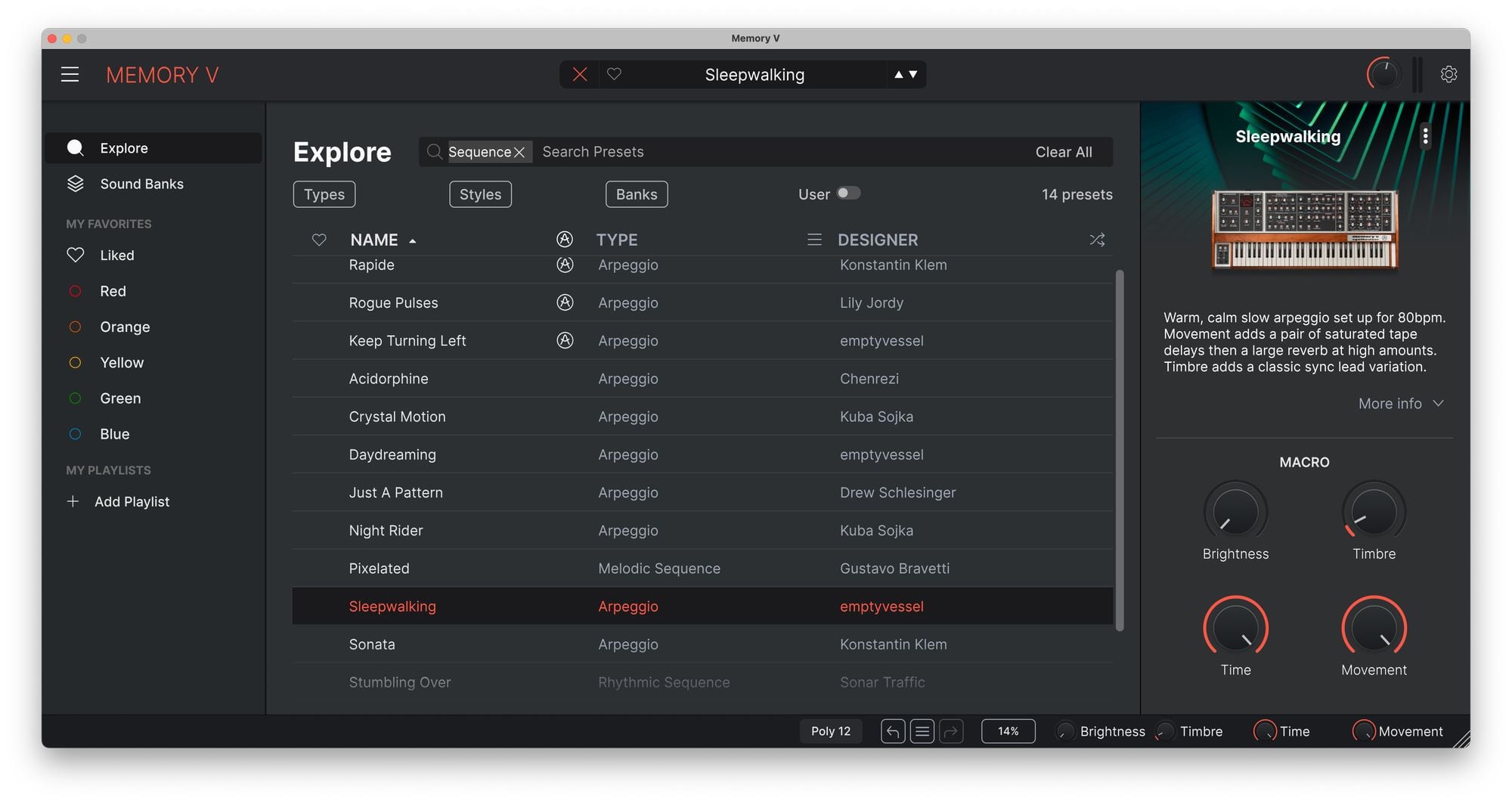
プリセット
ライブラリー

Explore 300+ presets that capture the many facets of Memory V, delivering dense front-of-mix polyphonic tone across vintage brass, cinematic pads, saturated basses, evolving textures and more.

ベース

Slap Back

Tim Mantle

The hardest FM slap. This sound behaves best towards the center of the keyboard, and will degrade further up or down the octaves.

Both Sides

Konstantin Klem

Fat bass with solid, upfront low end, cutting through the mix with power and clarity.

BRASS

Accent Horns

Kuba Sojka

Simple 80s synth brass with a sharp attack and an evolving crescendo.

For The Common Man

emptyvessel

Epic drama synth brass.

パッド

Muted Emotions

Sonar Traffic

Long muted pad with slow-grow filter opening.

Dust Belt

Tim Mantle

Galactic sci-fi soundscape, to be used with up to three notes at a time.

ストリングス

Drifting Memory

Lily Jordy

Bright vintage strings with an abundance of drift on pitch, chorus, and dispersion.

Glow In The Dark

Sonar Traffic

Slow building warm strings-pad with a bit of shimmer.

キーボード

Waiting For The Sun

Konstantin Klem

Airy, classic synth keys with a spacey feel and gentle pitch drift.

Triangle Tape Synth

Florian Marin

Tape echo drives this cute triangle lead.

効果音

Super Swarm

Gustavo Bravetti

Massive swarm-like FX driven by Unison and Super Unison.

Cyborg Extinction

Diego Tejeida

Monophonic sci-fi SFX.

Deep
Controls

Push the analog character of Memory V into entirely new sonic territory with a creative Advanced panel built for modern workflows.

Stack arpeggiator layers, create intricate rhythmic patterns, sculpt sound with drag-and-drop modulation, route MPE and aftertouch to any parameter, and shape your output with four slots of studio-grade effects, all from inside the instrument.

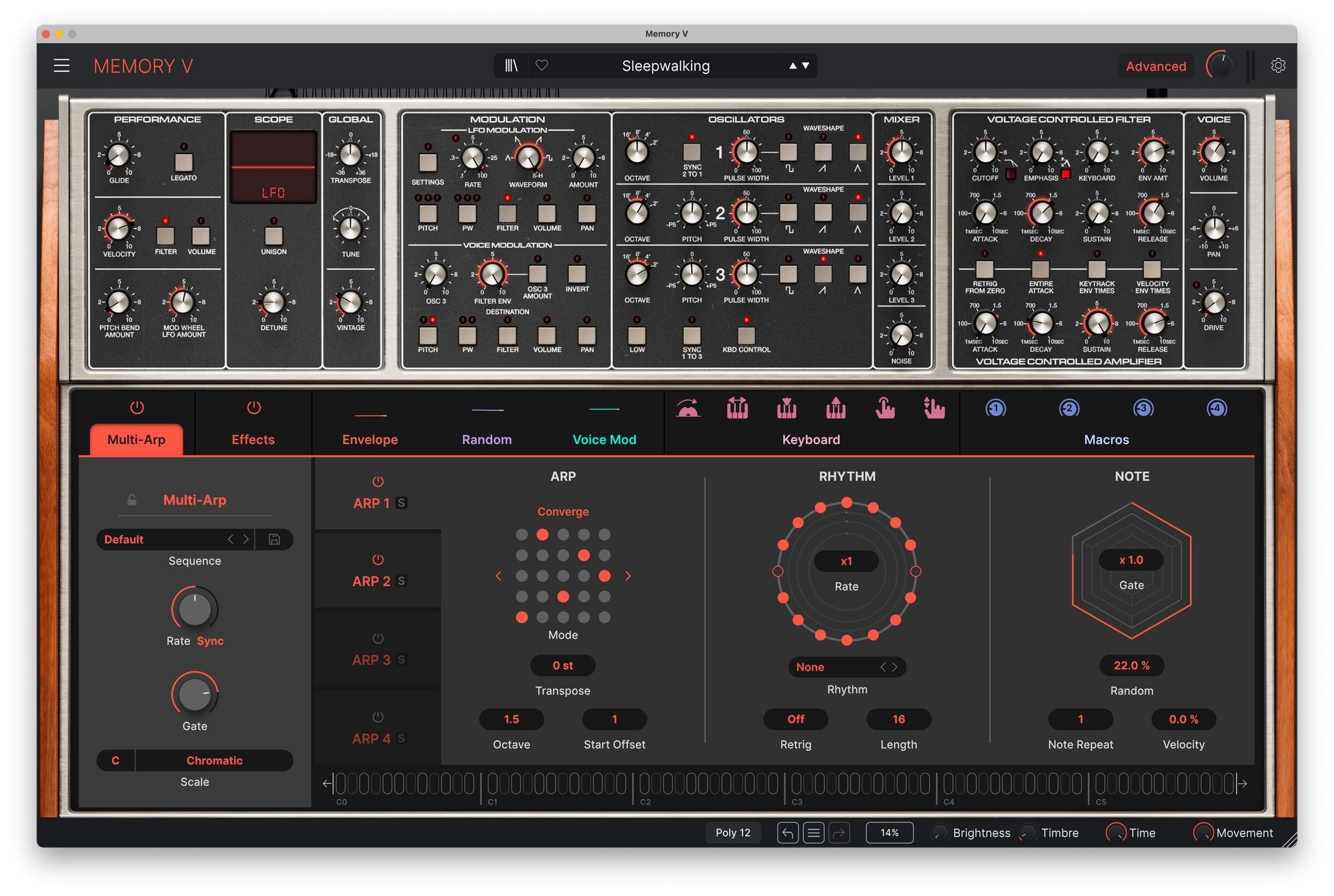
Stack up to four independent arpeggiator layers and build intricate, evolving patterns with ease. Create counterpoints, polymetric movement and transposed melodies for hypnotic textures that bring new possibilities to the Memorymoog voice architecture.

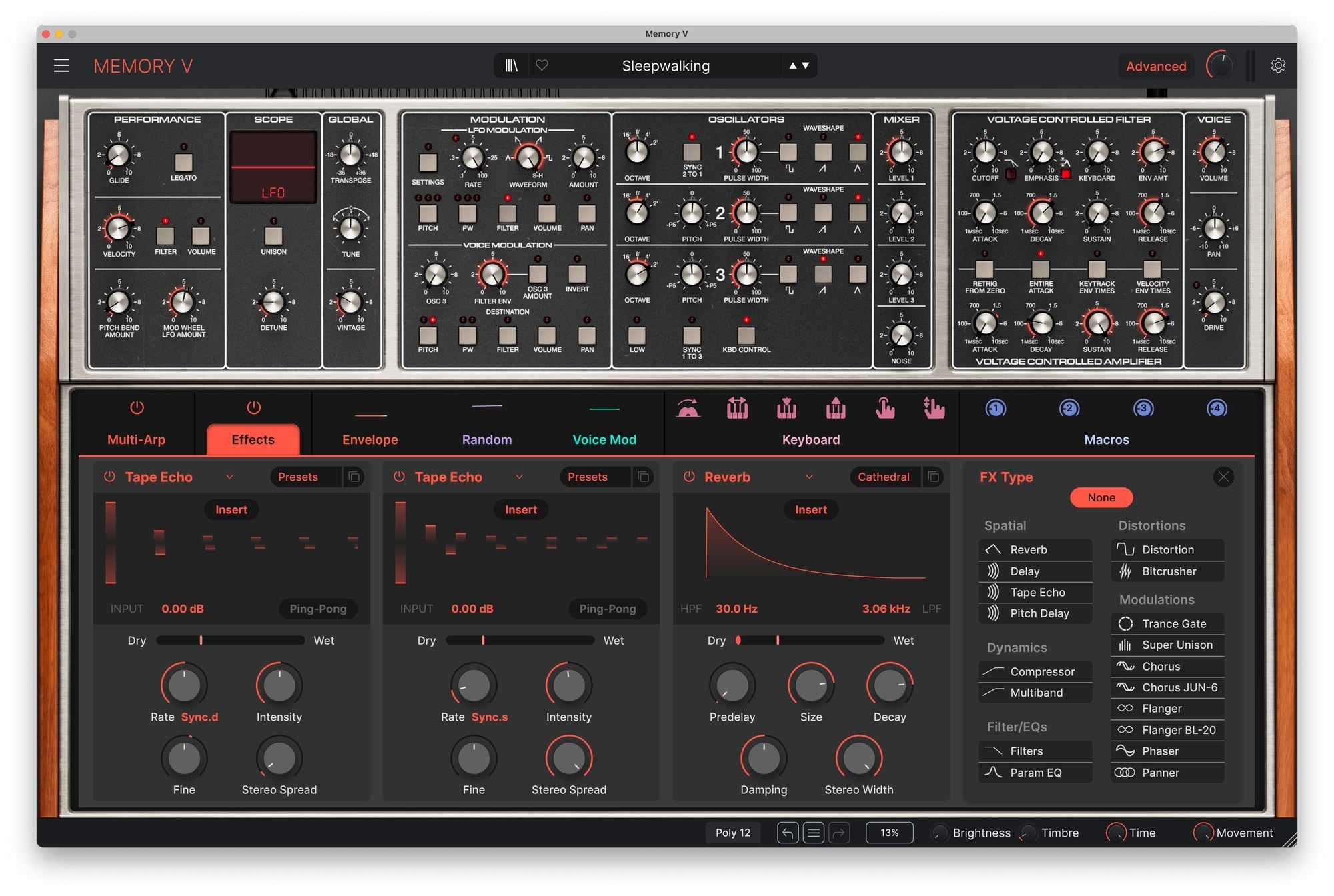
Four customisable effect slots give Memory V a complete studio-grade signal chain, with 17+ engines including Super Unison, Multi-Band Compressor, Chorus JUN-6, tape delay and reverb. Add polish, space, width or grit without leaving the instrument.

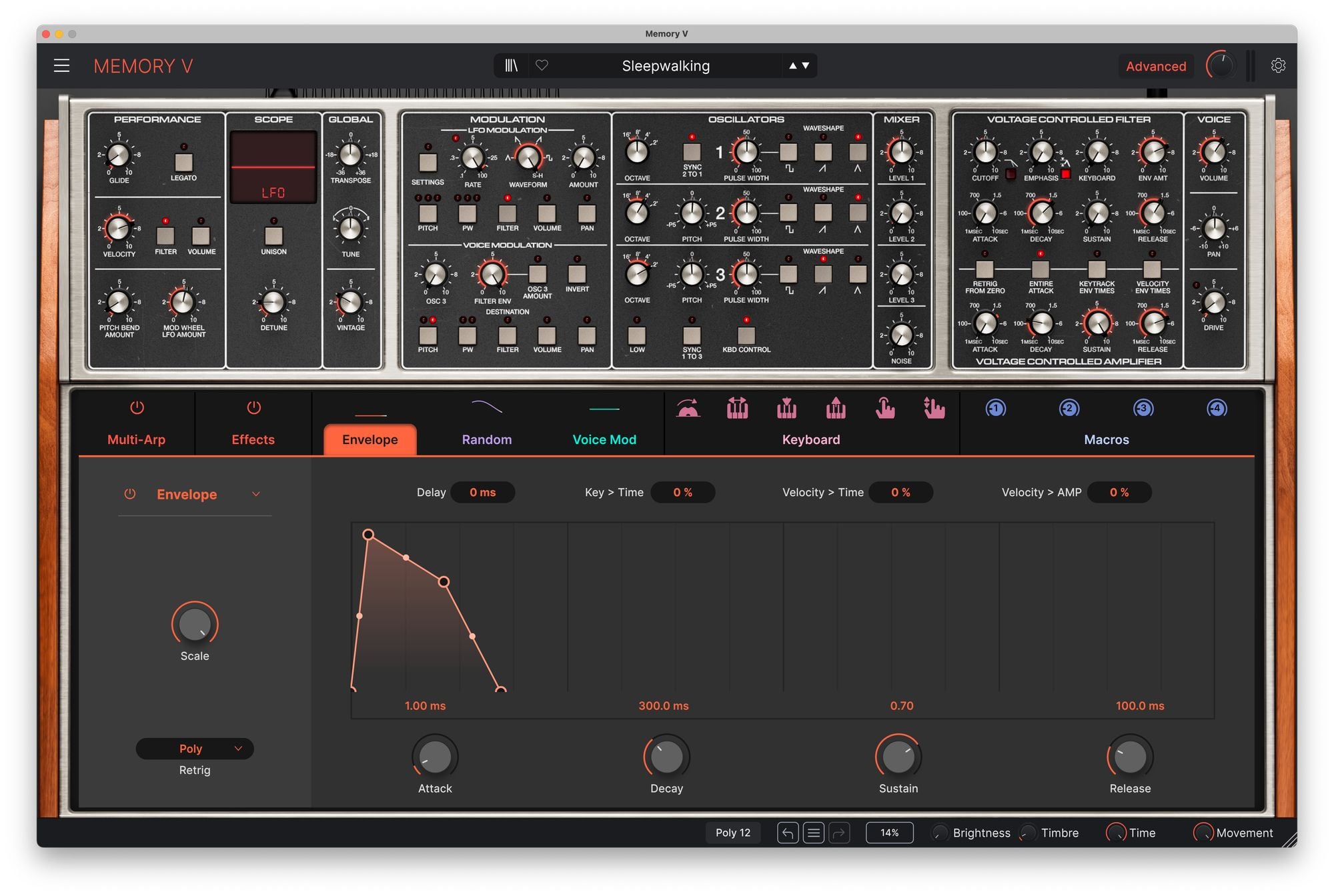
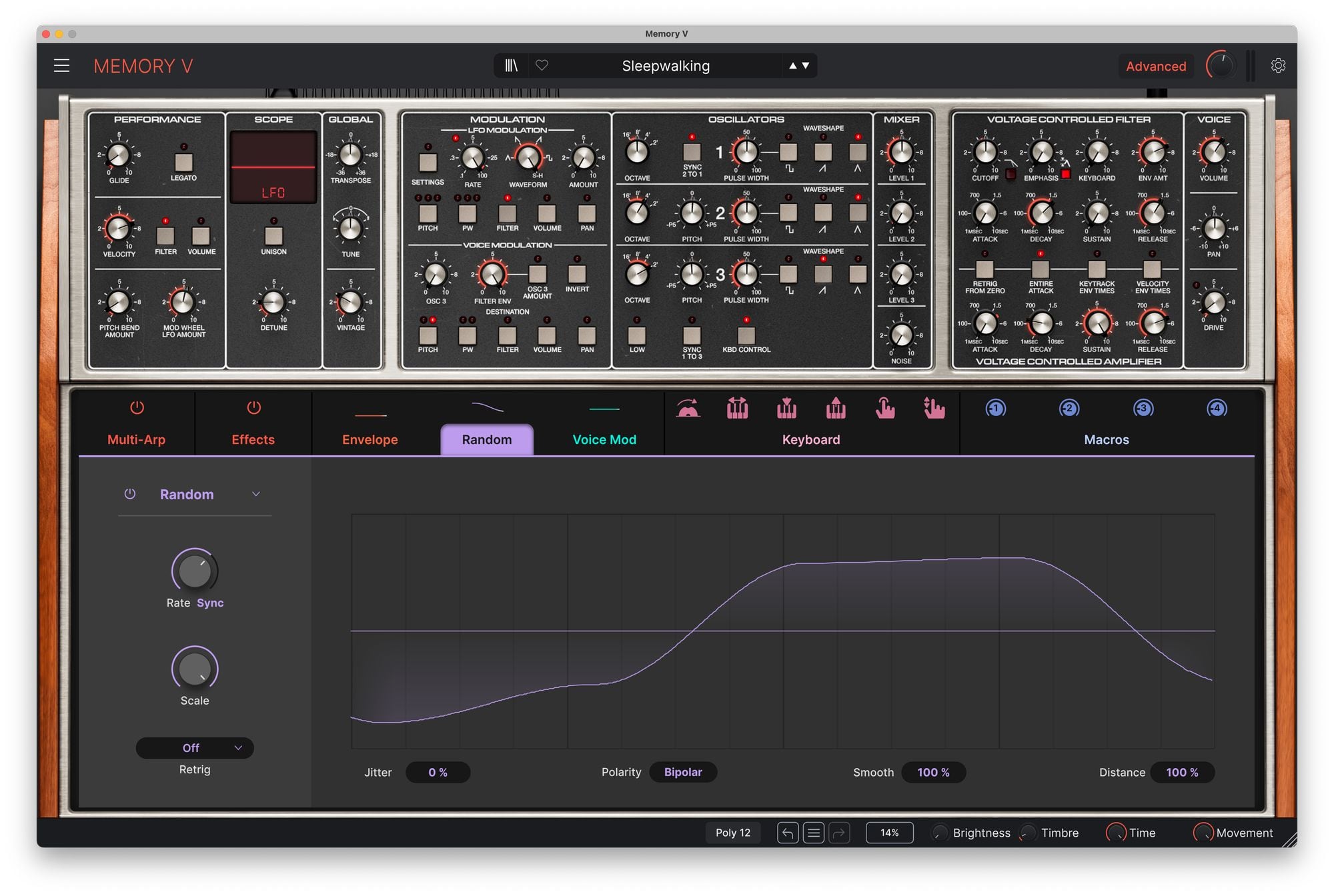
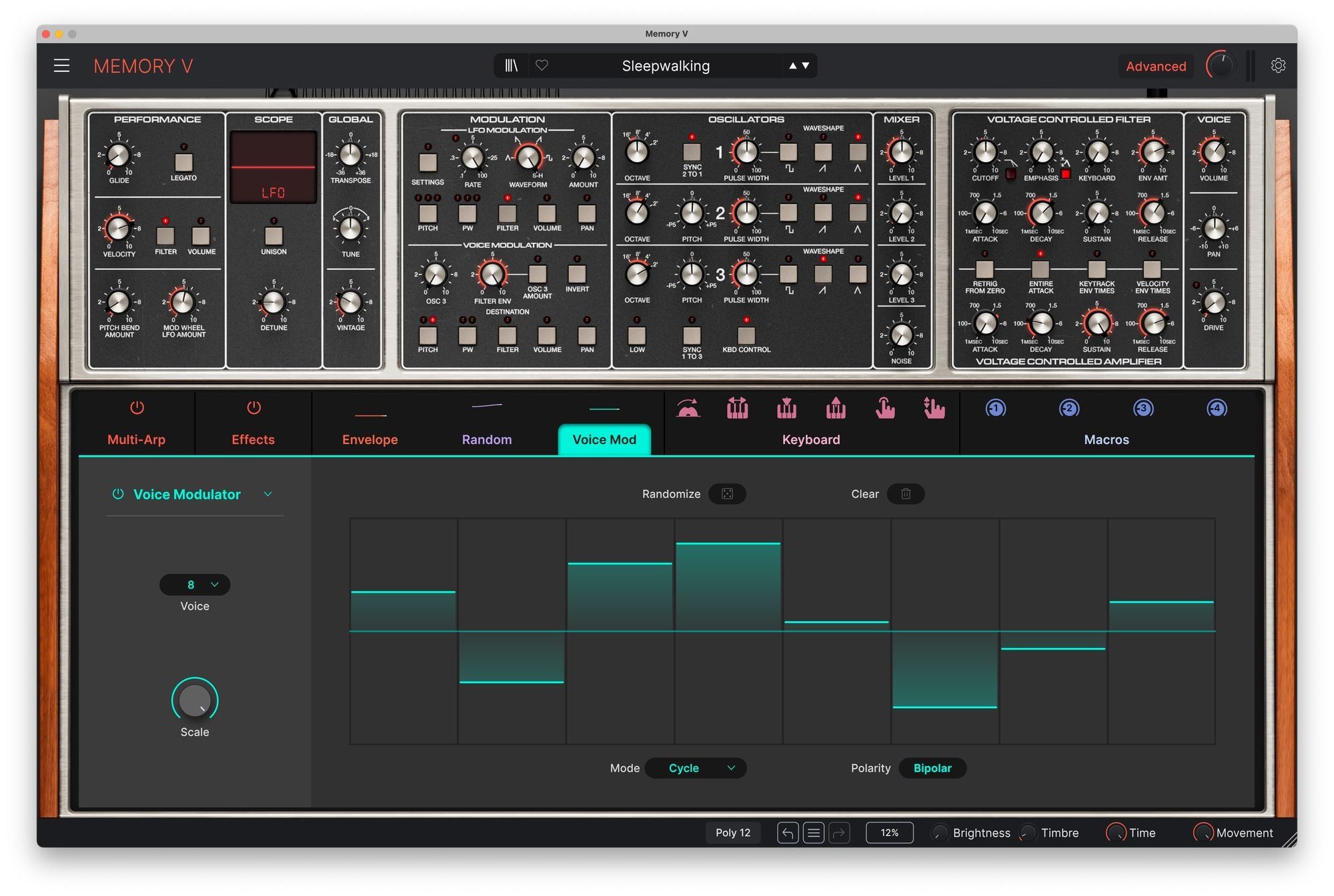
Three modulator slots let you build movement with envelopes, function generators, random LFOs, voice modulators and Mod Sequencer sources. Drag any source onto any destination, then hover to fine-tune the amount in seconds.

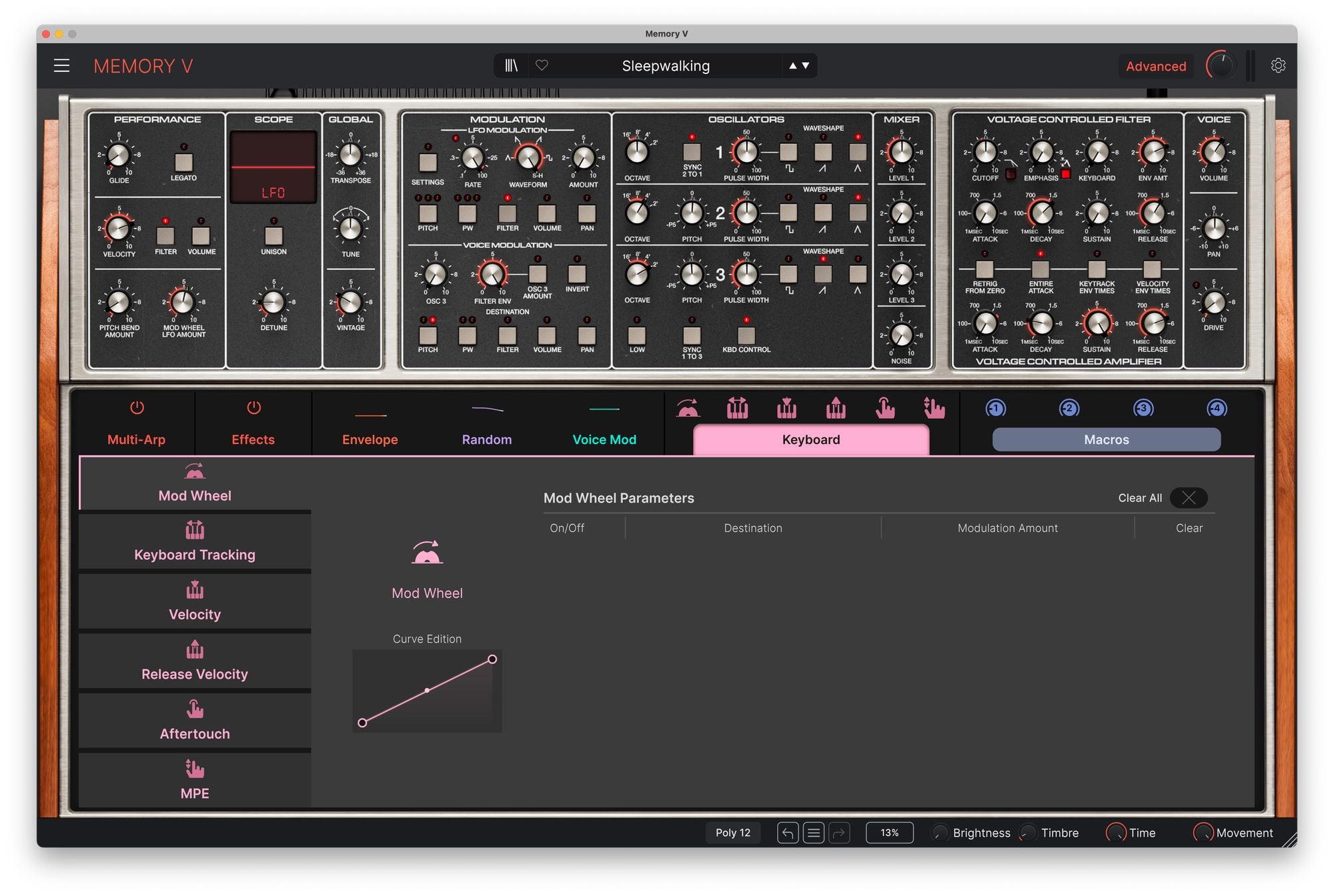
Memory V responds to every nuance of your playing. Assign velocity, release velocity, keyboard tracking, aftertouch, MPE slide and mod wheel to any parameter for expressive performances that go far beyond the original hardware.

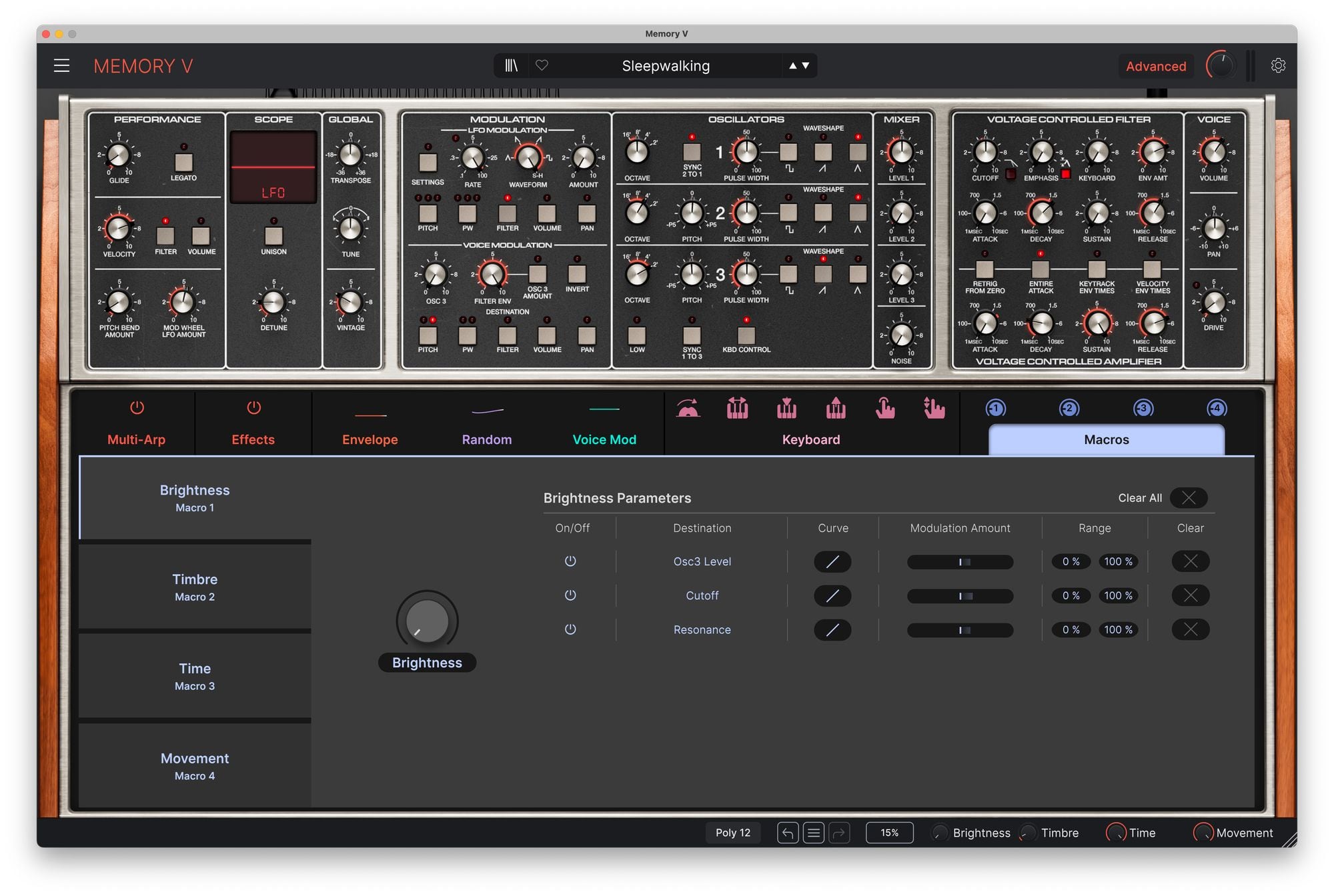
Four assignable macro controls make complex patches easy to perform. Map multiple parameters to a single control and reshape your sound live, from subtle variation to full tonal transformation.

Last of the
Moog legends

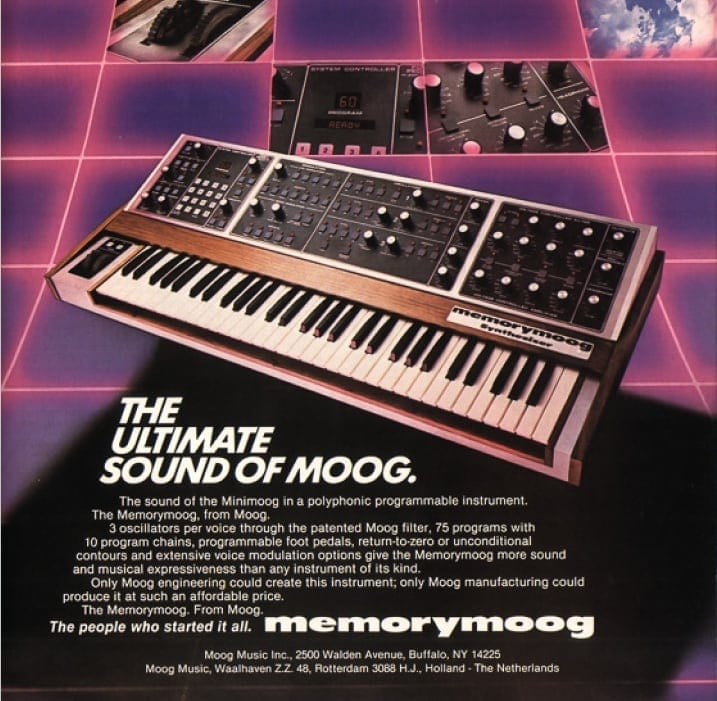
Released by Moog Music in 1982, the Memorymoog was the company's most ambitious polyphonic statement, and its final polyphonic synth before bankruptcy in 1987. Three oscillators per voice, a ladder filter and a sound that placed it alongside the Prophet-5 and OB-Xa as one of the defining polysynths of its era.

It was conceived as a polyphonic answer to the Minimoog: the same rich tone, opened up for chords, layered brass and wide harmonic movement. In a landscape of more restrained polysynth designs, the Memorymoog pushed toward something more ambitious. The result was a maximalist analog instrument with a reputation for depth, force and unpredictability.

A temperamental beast

The Memorymoog was as legendary for its sound as it was for its temperament. Its complex circuitry made it notoriously unstable, and engineers spoke of coaxing rather than playing it. When Moog Music declared bankruptcy in 1987, the dream of a polyphonic Moog seemed lost, and original units now trade for $15,000 or more once restored, with projects like the Lintronics Advanced Memorymoog upgrade extending their lives at extraordinary cost. Memory V resurrects the tone exactly as Bob Moog's team intended: all the magic, none of the temperament.

The sound of an era

The Memorymoog defined the polyphonic Moog character across early-80s synthpop, soundtrack and progressive rock. Geddy Lee of Rush relied on it for the iconic lead in Subdivisions. Tony Banks of Genesis turned to it for Mama and the Genesis album. Stevie Wonder, Tangerine Dream and countless film composers wove its dense tone into their sound, a character Memory V faithfully captures with TAE® component-level modelling.

Artist
Corner

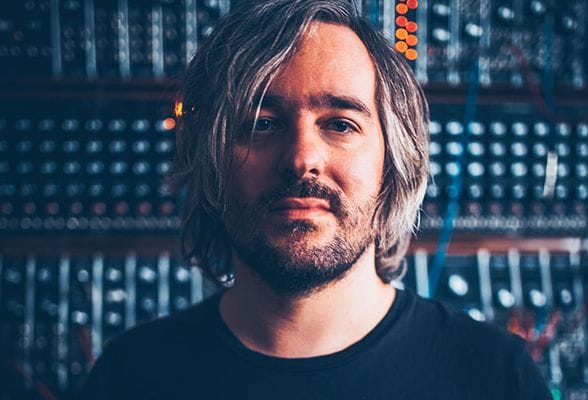
Paul Haslinger

Composer

"The Memory V recreates this beast of a machine, which has mythical status among musicians. Alongside the usual attention to detail, I really appreciate the additional voices, modulations and effects, making this a powerhouse virtual synth, worthy of its name!"

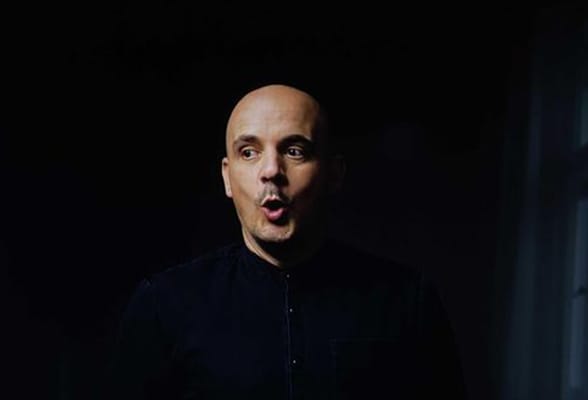
Hannes Bieger

Producer, sound engineer

"The Memorymoog is one of the most powerful sounding synthesizers ever made. Arturia have captured that main character energy beautifully!"

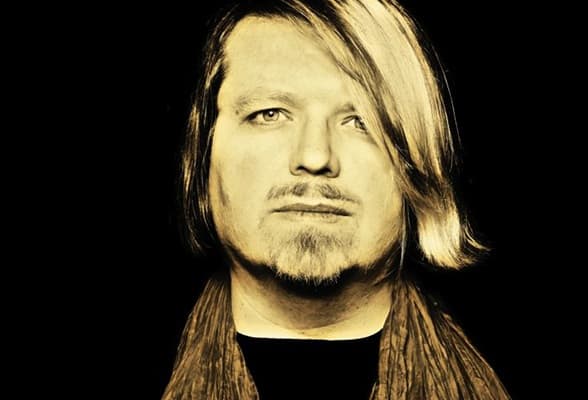
Headless Horseman

Prodcuer, Dj

"Feeling very inspired from the beauty, warmth and flexibility the Memory V has to offer. Jumping from ethereal pads to deep sonic experiments and back to bendy dramatic strings in seconds. Will get a lot of use out of this instrument in future productions. The ease of use, sound quality and smooth interface makes this a joy to work with."

プレス
掲載

Bonedo

On Memory V

"Arturia Memory V convincingly translates the legendary Memorymoog into the present day: monumentally broad, dense, and musical, with epic brass sounds, fat pads, powerful leads, modern modulation, strong effects, and precisely that meandering wall of sound that makes this synth myth so special even today. Without the headaches of the real hardware."

Future Music ES

On Memory V

"If you love analog sound, the recent and constantly evolving synthwave, vaporwave and lo-fi waves, Memory V will have a place in your DAW... Moog sound from a golden age with Arturia's quality seal in its emulation"

主な特長

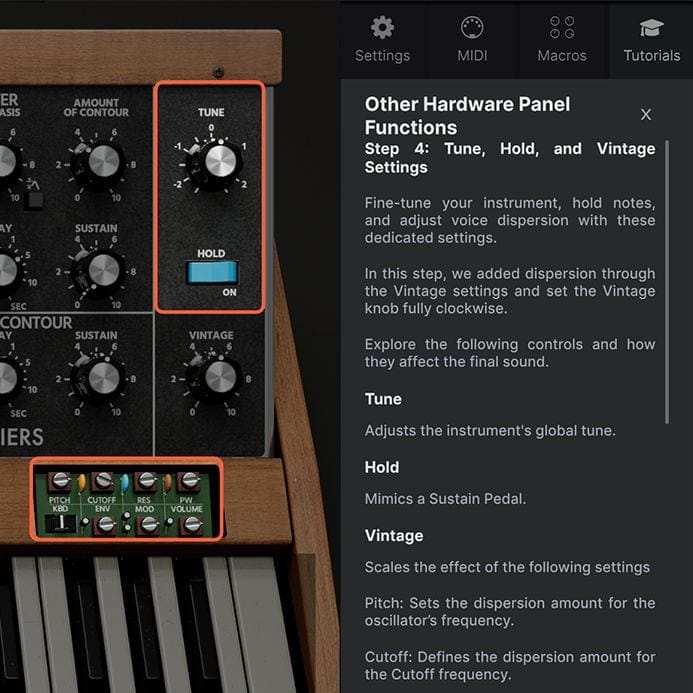
アプリ内チュートリアル

各パラメーターからサウンドデザイナーによるヒントまで、インストゥルメントのあらゆる側面について統合されたアプリ内チュートリアルがガイドしてくれますので、クリエイティブな作業に集中できます。こんなに簡単なことはありません!

ASC

Arturia Software Centerでは、すべてのArturiaソフトウェアタイトルのダウンロード、整理、アップデートを全て管理することができます。何事も可能な限りシンプルに。

DAW対応

Arturiaのバーチャルインストゥルメントとプラグインは、あなたのセットアップに簡単にフィットするように設計されています。制作スタイルを問わず、WindowsとMacOSの両方で、主要なDAWとの完全な互換性を楽しみながらサウンドを探求できます。

プリセットブラウザ

インテリジェントで効率的なプリセットブラウジングで、頭の中にあるサウンドを即座に見つけることができます。キーワードで検索したり、楽器の種類や音楽スタイルで探したり、お気に入りを登録して後ですぐに呼び出すこともできます。

リサイズ可能なGUI

Arturiaのクラシックなインストゥルメント・エミュレーションの視覚的な没入感を存分に味わいたい方にも、貴重なスクリーン面積を節約したい方にも、Arturiaのすべてのバーチャルインストゥルメントのインターフェイスは、用途に合ったサイズに変更できます。

完璧な統合

Arturiaのインストゥルメントは、KeyLabシリーズにシームレスにマッピングされていますが、他のMIDIコントローラーとの相性も抜群です。即座にサウンドをエディットできるマクロ、簡単なDAW統合、スタンドアローン動作も簡単です。

TAE®による高精度エミュレーション

独自のアナログモデリング技術により、オリジナルの実機と聞き分けがつかないほどの高精度エミュレーションを実現。

アナログ・オシレーター、フィルター、ソフト・クリッピングの特性も正確に再現することで、細かいコンポーネントの違いが生み出すディテールやアナログの魅力を体感することができます。

ギャラリー

effects
envelope
keyboard
macros
main
multi-arp
presets
random
voice-mod

主な特長

Polyphonic architecture

  • Memorymoog-inspired voice architecture

  • Poly 6 and Poly 12 voicing modes

  • Mono Retrig and Mono Legato modes

  • 3 free-running oscillators per voice plus Noise

  • Stackable Ramp, Triangle, and Square waveforms

  • Oscillator sync (1↔2 and 1↔3) and pulse width control

  • OSC 3 audio-rate modulator with Kbd Control on/off

Classic ladder-filter sound

  • Low-pass ladder filter per voice

  • 24 dB filter mode with optional 12 dB mode

  • Cutoff, Emphasis, keyboard tracking and filter envelope amount

  • Emphasis Bass Compensation

  • Dedicated filter and amplitude ADSR envelopes

  • Retrig From Zero, Entire Attack, Keytrack and Velocity envelope behaviour switches

Voice modulation

  • Voice Modulation with Oscillator 3 and Filter Envelope routing

  • Modulation destinations: pitch, pulse width, filter, volume and pan

Performance and expression

  • LFO with multiple waveforms, sync and retrig

  • Glide, velocity, pitch bend, mod wheel, Hold and Arp/Seq controls

  • Velocity routing to filter and volume

Enhanced analog control

  • Unison mode with Detune and variable voice count (2–6)

  • Pan and Stereo Spread

  • Vintage control knob

  • Dispersion controls for pitch, pulse width, levels, cutoff, emphasis, modulation and envelopes

  • Drive with clipping LED

Advanced creative tools

  • Advanced panel for arpeggiation, modulation and effects

  • Multi-Arp with 4 stacked arpeggiator layers

  • 3 modulator slots: Envelope, Function, Random, Voice Mod and Mod Sequencer

  • Keyboard and Macro modulators

  • 4-slot FX rack with 17+ effects

  • Oscilloscope visualisation: Output, LFO and Voice Mod

Modern software workflow

  • High-resolution skeuomorphic main view

  • Streamlined advanced editing panel

  • Resizable interface

  • Master Volume and output VU meter

  • MPE compatibility

  • MTS-ESP microtuning support

  • NKS controller compatibility

  • Arturia controller integration

Library

  • 300+ factory presets

  • In-App tutorials

  • Filter Envelope → OSC 3 Amount chained routing

  • Invert switch for filter envelope direction

プラットフォーム

Windows

  • Win 10+ (64bit)

  • 4 GB RAM

  • 4 cores CPU, 3.4 GHz (4.0 GHz Turbo-boost)

  • 3 GB free hard disk space

  • OpenGL 2.0 compatible GPU

  • ARM processors not supported on Windows

Required configuration

  • Works in Standalone, VST, AAX, Audio Unit, NKS (64-bit DAWs only).

Apple

  • Mac OS 11+

  • 4 GB RAM

  • 4 cores CPU, 3.4 GHz (4.0 GHz Turbo-boost) or M1 CPU

  • 3 GB free hard disk space

  • OpenGL 2.0 compatible GPU

Work with ASC

  • An elegant and simple solution to help you install, activate, and update your Arturia software instruments.

本ページに記載されているすべての社名、ブランド名および製品名は、各所有者に帰属する商標であり、Arturiaとは一切の提携または関連関係にありません。これらの商標は、開発過程で解析した製品の機能やサウンドを識別する目的でのみ使用しています。機器、発明者、企業およびブランドの名称は、例示および教育目的でのみ含まれており、それらによる推奨や提携を示すものではありません。